
GAY
FILM REVIEWS BY MICHAEL D. KLEMM


|
||||||
|
GAY
FILM REVIEWS BY MICHAEL D. KLEMM
|
||||||
|
|
|
|
|
|
|
|
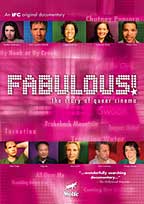
Fabulous!
Wolfe Video, 2006 Directors Unrated, 82 minutes |
Blazing
New Trails
Queer film history is one of my passions and Fabulous! The Story Of Queer Cinema is a damned good documentary, produced by The Independent Film Channel (in association with Wolfe Video, Netflix and Orchard Films), that manages to entertain while, at the same time, comprehensively survey the first trailblazers from the mid-1980s, through the 90s explosion of new queer films, up to the breakthrough success of Brokeback Mountain (2005). I make this time distinction at the onset because the emphasis of Fabulous is independent film, rather than being another history of Hollywood's sins against the gay community like The Celluloid Closet. These two films compliment each other, and The Celluloid Closet and Fabulous would make both a great double feature and a fine introduction to the complex saga of queer cinema. Fabulous features a treasure-trove of talking heads; most of them important directors, along with various actors, queer historians and critics. All are here providing their perspectives, anecdotes and memories. |
 The
documentary assembles people who know their subject. Fittingly, the film
begins with Kenneth Anger's Fireworks
(1947), the classic underground short that is arguably the first independent
film to be specifically about the gay experience. Though
Fabulous also employs an animated timeline with important
dates (i.e.: 1942-Gays banned in the military) the narrative suddenly
jumps to 1963 and the obscenity trials surrounding Jack Smith's underground
Flaming Creatures. This jarred me on my first viewing until I realized
that the filmmakers were not concerned with major studio releases; don't
expect to see major segments on The Boys
in the Band (1970), Cruising
(1980), Making Love
(1982), Philadelphia
(1993), or The Birdcage (1996).
Again, the emphasis here is (mostly American) independent cinema. The
documentary assembles people who know their subject. Fittingly, the film
begins with Kenneth Anger's Fireworks
(1947), the classic underground short that is arguably the first independent
film to be specifically about the gay experience. Though
Fabulous also employs an animated timeline with important
dates (i.e.: 1942-Gays banned in the military) the narrative suddenly
jumps to 1963 and the obscenity trials surrounding Jack Smith's underground
Flaming Creatures. This jarred me on my first viewing until I realized
that the filmmakers were not concerned with major studio releases; don't
expect to see major segments on The Boys
in the Band (1970), Cruising
(1980), Making Love
(1982), Philadelphia
(1993), or The Birdcage (1996).
Again, the emphasis here is (mostly American) independent cinema. |
|
|
|
|
|
Fabulous is filled with informed talking heads, including directors Gus Van Sant, Todd Haynes, John Waters, Rose Troche, John Cameron Mitchell, Ang Lee, Angela Robinson, Randy Barbado, Alice Wu and Don Roos. Other notables include actors Wilson Cruz, Alan Cumming and Jane Lynch, critic B. Ruby Rich, archivist Jenni Olson, Sundance programming director John Cooper, comic Maria Gomez and writer/activist Michelangelo Signorile. |
|
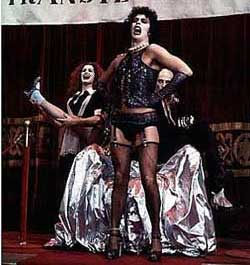 Okay,
and what do all these notable interview subjects have to say? We learn how
Stonewall galvanized the gay community in the 1970s, and how a film like
The Rocky Horror Picture Show
allowed queer kids to "don't dream it, be it." The appearance of video stores
in the 1980s caused a major shift as gays in small towns suddenly had access
to films previously unavailable to them. The 80s was a decade where gays
were no longer happy with being just a subculture, and AIDS forced countless
people into the political arena while invigorating gay and lesbian artists
to produce more challenging work.. Okay,
and what do all these notable interview subjects have to say? We learn how
Stonewall galvanized the gay community in the 1970s, and how a film like
The Rocky Horror Picture Show
allowed queer kids to "don't dream it, be it." The appearance of video stores
in the 1980s caused a major shift as gays in small towns suddenly had access
to films previously unavailable to them. The 80s was a decade where gays
were no longer happy with being just a subculture, and AIDS forced countless
people into the political arena while invigorating gay and lesbian artists
to produce more challenging work.. |
|
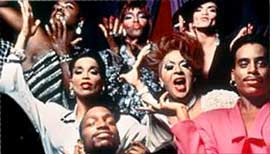 Gay
film festivals became a meeting place for those who shunned the bars. In
1991, Jennie Livingston's Paris is Burning and Todd Hayne's Poison
took the top jury prizes at the Sundance Film Festival. Things really
erupted in 1992, as Sundance became even more queer by screening
Derek Jarman's Edward II, Christopher
Munch's The Hours
and Times, Tom Kalin's Swoon
and Greg Arraki's The Living End.
Critic B. Ruby Rich reported this phenomenon in Sight & Sound and
called her article, "The New Queer Cinema" and the name stuck. Gay
film festivals became a meeting place for those who shunned the bars. In
1991, Jennie Livingston's Paris is Burning and Todd Hayne's Poison
took the top jury prizes at the Sundance Film Festival. Things really
erupted in 1992, as Sundance became even more queer by screening
Derek Jarman's Edward II, Christopher
Munch's The Hours
and Times, Tom Kalin's Swoon
and Greg Arraki's The Living End.
Critic B. Ruby Rich reported this phenomenon in Sight & Sound and
called her article, "The New Queer Cinema" and the name stuck. |
|
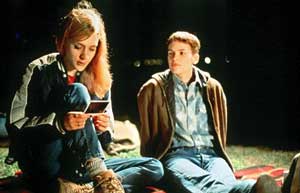 With
this new visibility also came a backlash. Michelangelo Signorile refers
to "an enormous chill coming out of Washington" as homophobic forces in
government went after queer artists that were funded by the National Endowment
for the Arts. Ellen Degeneres came out on TV and in Time Magazine.
Queer directors began to make films in Hollywood (like Haynes' Far From
Heaven), while many queer independents become less edgy and embraced
more comedic and mainstream formats. Transgender themes suddenly proliferate,
along with films about other niche segments of the gay population. Video
put cameras into the hands of more filmmakers and DVDs allowed their work
to reach an audience. Hillary Swank won a best actress Oscar for Boys
Don't Cry (as Tom Hanks did for Philadelphia)
and suddenly straight actors were more willing to play gay to hone their
craft and win awards. With
this new visibility also came a backlash. Michelangelo Signorile refers
to "an enormous chill coming out of Washington" as homophobic forces in
government went after queer artists that were funded by the National Endowment
for the Arts. Ellen Degeneres came out on TV and in Time Magazine.
Queer directors began to make films in Hollywood (like Haynes' Far From
Heaven), while many queer independents become less edgy and embraced
more comedic and mainstream formats. Transgender themes suddenly proliferate,
along with films about other niche segments of the gay population. Video
put cameras into the hands of more filmmakers and DVDs allowed their work
to reach an audience. Hillary Swank won a best actress Oscar for Boys
Don't Cry (as Tom Hanks did for Philadelphia)
and suddenly straight actors were more willing to play gay to hone their
craft and win awards. |
|
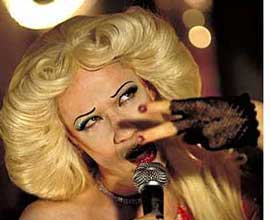 Director
John Cameron Mitchell (Hedwig
and the Angry Inch, 2002) observes that "When you're gay, you grow
up not telling the truth right away, so you are aware of artifice, you're
aware of acting and you're aware of things exaggerated, you also understand
metaphor" and so you can, for example, project yourself into one of the
two straight people kissing on the screen. Director Randy Barbados comments
on how drag freed us to be ourselves, and director Rose
Troche talks about how she wanted Go Fish
to be about a group of women who were so beyond coming out before
the film's action even began. Actor Wilson
Cruz talks about being told that he can't be out and still succeed
in show business and how he set out to prove them wrong, and writer Billy
Porter explains how the lighter queer faire emerged because we lived "for
a decade in death and the romantic comedy was a way to re-introduce hope
into an entire culture of people." Director
John Cameron Mitchell (Hedwig
and the Angry Inch, 2002) observes that "When you're gay, you grow
up not telling the truth right away, so you are aware of artifice, you're
aware of acting and you're aware of things exaggerated, you also understand
metaphor" and so you can, for example, project yourself into one of the
two straight people kissing on the screen. Director Randy Barbados comments
on how drag freed us to be ourselves, and director Rose
Troche talks about how she wanted Go Fish
to be about a group of women who were so beyond coming out before
the film's action even began. Actor Wilson
Cruz talks about being told that he can't be out and still succeed
in show business and how he set out to prove them wrong, and writer Billy
Porter explains how the lighter queer faire emerged because we lived "for
a decade in death and the romantic comedy was a way to re-introduce hope
into an entire culture of people." |
|
|
It is also much appreciated when documentaries have a sense of humor. One of the funniest sequences was historian Jenni Olson presenting a montage of trailers for horrendous 1960s dykesploitation flicks with titles like The Cats. Think Reefer Madness and Glen or Glenda with a dollop of Valley of the Dolls. Those were the days. Not! Film clips like these are priceless. |
|
|
While I lament the absence of a few important films (like John Sayles' Lianna, 1983, John Grayson's Zero Patience, 1993 and P.J. Castellaneta's Relax... It's Just Sex (1998),there's no way you can get all of them in and I am very impressed by the wealth of titles included. I also liked that gay films and lesbian films were equally represented and also that transgender titles were given their due. I just wish the fillmmakers had chosen a different title; Fabulous makes the film sound as if it was made for MTV and not The Independent Film Channel. But, all in all, this is a fine documentary that was obviously made by people who love these films and preserve their memory. And, for those who want more, the Bonus Features include interview outtakes where the subjects of coming out, first gay movie memories and favorite love scenes are amongst the topics addressed. Fabulous continues where The Celluloid Closet leaves off. As stated earlier, a double feature of these two documentaries will both entertain and educate audiences concerning everything you always wanted to know about queer cinema but were afraid to ask. Highly recommended.
See
also:
|
|
 CLICK THE ABOVE BANNER TO PURCHASE THIS WOLFE VIDEO TITLE |
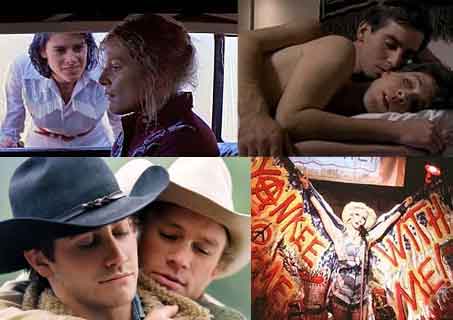
 From
there we proceed chronologically through highlights such as
From
there we proceed chronologically through highlights such as 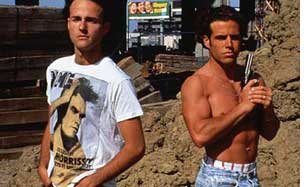 While
impossible to include every important feature from the time, Fabulous
does a good job at presenting the most important ones, with ample clips,
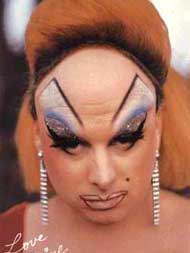
from the edgy Paris is Burning (1990), Poison (1991),
While
impossible to include every important feature from the time, Fabulous
does a good job at presenting the most important ones, with ample clips,
from the edgy Paris is Burning (1990), Poison (1991),
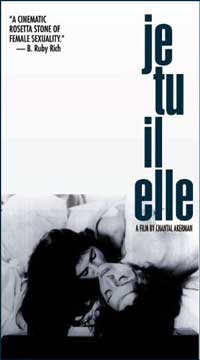 One
of the joys of watching a documentary is learning new things and I discovered
a few important films that were totally unknown to me. The filmmakers
have certainly done their research. I was completely unaware of a black
and white Belgian-French film by Chantal Akerman named Je, tu, il,
elle (1974) that featured a ten minute love scene between two women
artsily filmed in longshot in one lengthy take. Another that slipped under
my radar was from the African American gay perspective, 2000's Punks,
written and directed by Patrik-Ian Polik (Noah's Arc), a black
man tired of movies about 17 year-old white kids coming out. Arthur Dong's
Family Fundamentals (2002) documents the homophobia of uber-religious
parents. Harriet Dodge and Silas Howard's By Hook Or By Crook (2001),
along with Jonathan Caouette's Tarnation (2004), are both very
experimental films shot on video, and are described by several of the
talking heads as signpoints to the next wave of queer cinema.
One
of the joys of watching a documentary is learning new things and I discovered
a few important films that were totally unknown to me. The filmmakers
have certainly done their research. I was completely unaware of a black
and white Belgian-French film by Chantal Akerman named Je, tu, il,
elle (1974) that featured a ten minute love scene between two women
artsily filmed in longshot in one lengthy take. Another that slipped under
my radar was from the African American gay perspective, 2000's Punks,
written and directed by Patrik-Ian Polik (Noah's Arc), a black
man tired of movies about 17 year-old white kids coming out. Arthur Dong's
Family Fundamentals (2002) documents the homophobia of uber-religious
parents. Harriet Dodge and Silas Howard's By Hook Or By Crook (2001),
along with Jonathan Caouette's Tarnation (2004), are both very
experimental films shot on video, and are described by several of the
talking heads as signpoints to the next wave of queer cinema.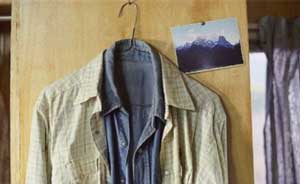 After
winding down with the artistic and mainstream breakthrough of
After
winding down with the artistic and mainstream breakthrough of