
GAY
FILM REVIEWS BY MICHAEL D. KLEMM


|
||||||
|
GAY
FILM REVIEWS BY MICHAEL D. KLEMM
|
||||||
|
|
|
|
|
|
|
|
A
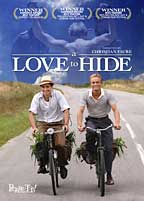
Love To Hide PictureThis!
Entertainment Director:
Screenplay:
Starring:
Unrated, 102 minutes |
Pink
Triangles
"It
was not until 2001 that the deportation of homosexuals was officially
recognized by the French State. The deportation of German homosexuals
began in 1933 with the Nazis' rise to power, then spread to annexed countries.
According to the U.S. Holocaust memorial, 100,000 homosexuals were arrested
between 1933 and 1945. 10,000 to 15,000 died in camps. The 1942 law criminalizing
homosexuality was upheld at the Liberation. It wasn't repealed until 1981." |
|
The setting is Paris in 1942 during the German occupation and the viewer is immediately drawn into the story right from its arresting opening shot. A young woman is seen desperately trying to climb out from a hole, her hands grasping at the dirt. A close-up of jackboots goose-step across the screen. The woman emerges from a hiding place into the pouring rain. She looks around and then angrily rips the yellow star from her tattered dress. |
|
|
|
|
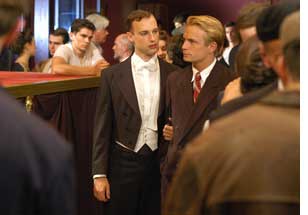 Jean's
family runs a laundry service and Sara is allowed to work there. Jean's
parents (Michel Jonasz and Charlotte
de Turckheim) do not recognize her and, for now at least, the subterfuge
works. Trouble is on the horizon, however, when Jean's brother, Jacques
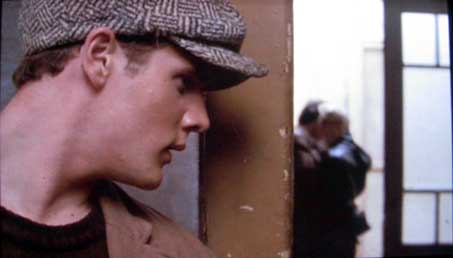
(Nicolas Gob), is released from prison. Jacques was a black marketeer and
he resumes trafficking as soon as he is home again, selling the addresses
of his family's Jewish customers (those who have disappeared) to a corrupt
captain of the police so that he can fence their abandoned goods. Jacques
takes a fancy to Sara and this volatile situation explodes when he also
discovers that his brother and Phillipe are a pair of poufs. Jean's
family runs a laundry service and Sara is allowed to work there. Jean's
parents (Michel Jonasz and Charlotte
de Turckheim) do not recognize her and, for now at least, the subterfuge
works. Trouble is on the horizon, however, when Jean's brother, Jacques
(Nicolas Gob), is released from prison. Jacques was a black marketeer and
he resumes trafficking as soon as he is home again, selling the addresses
of his family's Jewish customers (those who have disappeared) to a corrupt
captain of the police so that he can fence their abandoned goods. Jacques
takes a fancy to Sara and this volatile situation explodes when he also
discovers that his brother and Phillipe are a pair of poufs. |
|
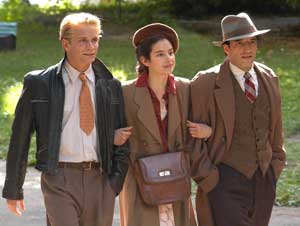 In
spite of the dangerous wartime setting, the first half hour is a delightful
character study of three people whose love for each other transcends the
tumultuous emotional toil that could easily destroy them. Sara accepts Jean
and Phillipe's relationship even though she would give anything to have
her first love all to herself. The viewer is treated to idyllic bicycle
rides through lush country scenery as the trio grasp at whatever straws
of happiness they can share, knowing full well that the world can come crashing
down on them at any moment. Jean and Phillipe playfully wrestle in a pastoral
stream, the three walk arm in arm through the streets of Paris, Sara happily
between the two lovers. I'm not saying that there isn't tension between
the three. Jean admits to Phillipe that he does love Sara, but not
in the same way that he loves him. All he asks of Phillipe is that he help
Sara and not let her down. He shows what tenderness he can to Sara without
leading her on. "You're the only woman I could love," Jean tells
her, "But I'd ruin you." In
spite of the dangerous wartime setting, the first half hour is a delightful
character study of three people whose love for each other transcends the
tumultuous emotional toil that could easily destroy them. Sara accepts Jean
and Phillipe's relationship even though she would give anything to have
her first love all to herself. The viewer is treated to idyllic bicycle
rides through lush country scenery as the trio grasp at whatever straws
of happiness they can share, knowing full well that the world can come crashing
down on them at any moment. Jean and Phillipe playfully wrestle in a pastoral
stream, the three walk arm in arm through the streets of Paris, Sara happily
between the two lovers. I'm not saying that there isn't tension between
the three. Jean admits to Phillipe that he does love Sara, but not
in the same way that he loves him. All he asks of Phillipe is that he help
Sara and not let her down. He shows what tenderness he can to Sara without
leading her on. "You're the only woman I could love," Jean tells
her, "But I'd ruin you." |
|
|
This is but a sketch of the complex tale that unfolds in the first third and I will leave it to my readers to discover the rest of this harrowing film on their own. There won't be spoilers ahead, but this is a story that examines the treatment of homosexuals at the hands of the Nazis and it goes without saying that the viewer is going to be assualted by a tragedy of operatic dimensions. What is uplifting about A Love To Hide is the experience of watching ordinary people who try to retain their humanity in spite of the inconceivable horror besetting their lives. |
|
 |
|
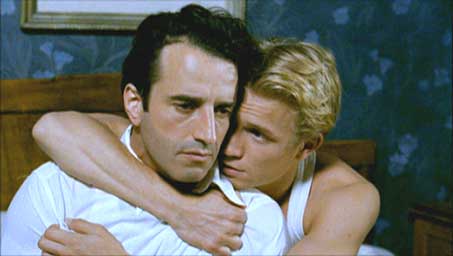
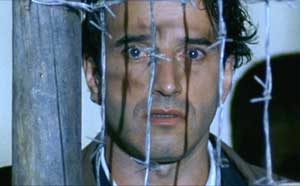
| It is ironic that the blonde Jean embodies the physical traits of the "Aryan superman" while also standing for everything that the Nazis hate. The complexity of each of the characters weave a rich and compelling tapestry that will ensnare the viewer. War brings out the best and the worst in mankind; good people will do bad things and vice versa. Jacques will collaborate with the enemy to try to undo the damage he has caused and Sara, early on, tries to kill the man who betrayed her family. There is a scene in a concentration camp that is the stuff of nightmares but in the midst of it is an image of a gay prisoner boldly affirming his identity that will forever be burned into my consciousness as the most heroic act of defiance I have ever seen in a movie. | |
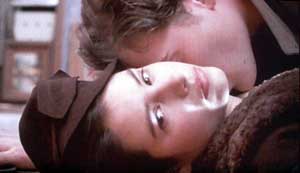 The
director, Faure, has an excellent cinematic eye and employs many subtle
images that speak volumes without words. Look, for example, at the moment
when Phillipe first sees Sara and he glimpses the outlines of yellow thread
on her dress from where she removed the incriminating star. Faure also knows
how to frame a close-up for maximum effect to convey a character's mood,
be it joy, sorrow, anger or terror. His lyrical camera movements often glide
to reveal hidden dangers. The script is filled with incidental touches that
all contribute to a complete portrait; little bits like a worker at the
laundry helping herself to clothing that she knows that no one is coming
back for. One certainly gets an accurate sense of history. Like Martin Sherman's
Bent, this film also makes it clear that wearing a pink triangle
in the camps signifies that you are the lowest of the low. The
director, Faure, has an excellent cinematic eye and employs many subtle
images that speak volumes without words. Look, for example, at the moment
when Phillipe first sees Sara and he glimpses the outlines of yellow thread
on her dress from where she removed the incriminating star. Faure also knows
how to frame a close-up for maximum effect to convey a character's mood,
be it joy, sorrow, anger or terror. His lyrical camera movements often glide
to reveal hidden dangers. The script is filled with incidental touches that
all contribute to a complete portrait; little bits like a worker at the
laundry helping herself to clothing that she knows that no one is coming
back for. One certainly gets an accurate sense of history. Like Martin Sherman's
Bent, this film also makes it clear that wearing a pink triangle
in the camps signifies that you are the lowest of the low. |
|
|
More
On Director Christian Faure: Charlotte
de Turckheim also appears in |
 Christian
Faure's A Love To Hide is a
French film about the persecution of both Jews and homosexuals during
the Holocaust that is every bit the equal of better known faire such as
Stephen Spielberg's Schindler's List. I realize that these words
are high praise indeed, but I assure you that this is not empty hyperbole.
Christian
Faure's A Love To Hide is a
French film about the persecution of both Jews and homosexuals during
the Holocaust that is every bit the equal of better known faire such as
Stephen Spielberg's Schindler's List. I realize that these words
are high praise indeed, but I assure you that this is not empty hyperbole.
 Not
knowing where else to turn, Sara (Louise Monot) looks up a childhood friend
named Jean (Jeremie Renier). Jean is surprised to see her and is shocked
to learn that she witnessed her entire family being killed by the Nazis
when they were betrayed by the man whom they believed would help them
escape. Jean and Sara were childhood sweethearts when both their families
used to vacation in the country and she is still in love with him. He
takes her to his friend Phillipe's apartment to ask if she can stay with
him. Phillipe (Bruno Todeschini) is a member of the Resistance. He is
a printer with a talent for forging papers and Sara is given a new identity.
The poor, terrified girl is grateful but she receives yet another jolt
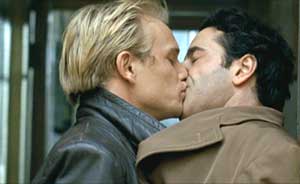
when she sees Jean and Phillipe exchange a passionate kiss and Jean confesses
that they have been lovers for four years.
Not
knowing where else to turn, Sara (Louise Monot) looks up a childhood friend
named Jean (Jeremie Renier). Jean is surprised to see her and is shocked
to learn that she witnessed her entire family being killed by the Nazis
when they were betrayed by the man whom they believed would help them
escape. Jean and Sara were childhood sweethearts when both their families
used to vacation in the country and she is still in love with him. He
takes her to his friend Phillipe's apartment to ask if she can stay with
him. Phillipe (Bruno Todeschini) is a member of the Resistance. He is
a printer with a talent for forging papers and Sara is given a new identity.
The poor, terrified girl is grateful but she receives yet another jolt
when she sees Jean and Phillipe exchange a passionate kiss and Jean confesses
that they have been lovers for four years.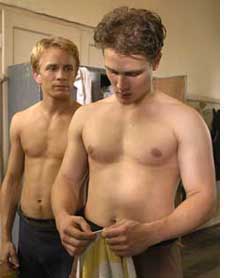 When
Jacques confronts his brother about Phillipe, Jean is devastated by the
violence of his insults. "I detested myself for years," Jean confesses.
When Jacques insists that Jean should deny his true nature, and tells
him he can choose, Jean asks "Did you choose the color of your
eyes?" This is a powerful scene and there is relief when their brotherly
love for each other wins out in the end. But tragedy is set in motion
when Sara refuses Jacques' drunken attempt at seduction and the incident
escalates into a fight between the brothers. Jacques, angry and humiliated,
decides to teach Jean a lesson that backfires horribly.
When
Jacques confronts his brother about Phillipe, Jean is devastated by the
violence of his insults. "I detested myself for years," Jean confesses.
When Jacques insists that Jean should deny his true nature, and tells
him he can choose, Jean asks "Did you choose the color of your
eyes?" This is a powerful scene and there is relief when their brotherly
love for each other wins out in the end. But tragedy is set in motion
when Sara refuses Jacques' drunken attempt at seduction and the incident
escalates into a fight between the brothers. Jacques, angry and humiliated,
decides to teach Jean a lesson that backfires horribly. 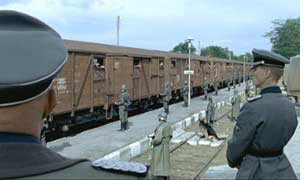 I
often invoke Truffaut when I am impressed by a French film but, this time,
the comparison is more than apt. The opening hour exhibits both the charm
and the tragedy of Truffaut's Jules and Jim except that, instead
of two men loving the same woman, a man is loved by two people of opposite
genders. The kisses shared between Jean and Phillipe are those of two
men who truly love each other and, even though we never see them have
sex, their passion is honest and convincing. A
Love To Hide is exquisitely filmed, and acted, and I honestly
cannot find a single flaw in its execution. While there is no clear "star,"
it often seems that the weight of everything falls on the shoulders of
Sara and it is she who is the window into the film's soul. This is a grueling
film, make no mistake about it, but one's diet should include more than
just fluffy queer sex comedies. Anyone who loves cinema owes it to themselves
to see this powerful film. I don't think any of my readers need reminding
that forces of homophobia still exist around the world. Never understimate
the power of hate but always remember how resilient the human spirit can
be. A Love To Hide is a film
I will never forget.
I
often invoke Truffaut when I am impressed by a French film but, this time,
the comparison is more than apt. The opening hour exhibits both the charm
and the tragedy of Truffaut's Jules and Jim except that, instead
of two men loving the same woman, a man is loved by two people of opposite
genders. The kisses shared between Jean and Phillipe are those of two
men who truly love each other and, even though we never see them have
sex, their passion is honest and convincing. A
Love To Hide is exquisitely filmed, and acted, and I honestly
cannot find a single flaw in its execution. While there is no clear "star,"
it often seems that the weight of everything falls on the shoulders of
Sara and it is she who is the window into the film's soul. This is a grueling
film, make no mistake about it, but one's diet should include more than
just fluffy queer sex comedies. Anyone who loves cinema owes it to themselves
to see this powerful film. I don't think any of my readers need reminding
that forces of homophobia still exist around the world. Never understimate
the power of hate but always remember how resilient the human spirit can
be. A Love To Hide is a film
I will never forget.