
GAY
FILM REVIEWS BY MICHAEL D. KLEMM


|
||||||
|
GAY
FILM REVIEWS BY MICHAEL D. KLEMM
|
||||||
|
|
|
|
|
|
|
|
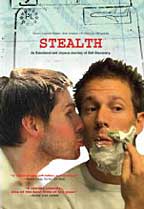
Stealth Waterbearer Films, 2006
Director/Screenplay: Starring:
Unrated, 112 minutes
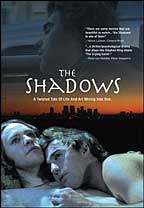
The Shadows Waterbearer Films. 2007 Director/Screenplay: Starring: Unrated, 80 minutes |
Short
Clips
Stealth is an odd film by director Lionel Baier (Garcon Stupide) that examines identity confusion on both national and sexual levels. Lionel Baier (the writer/director playing himself?) is a young gay author living in Lausanne, the French-speaking region of Switzerland. He works for a Swiss radio station and lives openly with his loving boyfriend, Serge (Stephane Rentznik). His relationship is accepted by both his parents and his sister, Lucie (Natacha Koutchoumov). Lionel is happy and carefree until his world is turned upside down one day when he discovers that his great grandfather was Polish. |
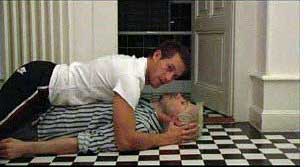 His
unknown heritage sparks an amusing journey of self discovery. Lionel immerses
himself in everything Polish that he can find and begins to learn the language.
His obsession goes a little too far when he meets a pretty young Polish
woman (Alicja Bachleda-Curus), who is living in Switzerland illegally, and
he decides to marry her so that she can stay in the country. His relationship
with Serge is now in tatters, his parents are confused (but pleased) while
his sister Lucie comically screams "Your son wants to marry a girl and that's
normal?" Fed up with her brother's irrational behavior, she literally
kidnaps Lionel and drives him to Poland where they can discover their ancestral
roots and put his newfound fixation to rest. His
unknown heritage sparks an amusing journey of self discovery. Lionel immerses
himself in everything Polish that he can find and begins to learn the language.
His obsession goes a little too far when he meets a pretty young Polish
woman (Alicja Bachleda-Curus), who is living in Switzerland illegally, and
he decides to marry her so that she can stay in the country. His relationship
with Serge is now in tatters, his parents are confused (but pleased) while
his sister Lucie comically screams "Your son wants to marry a girl and that's
normal?" Fed up with her brother's irrational behavior, she literally
kidnaps Lionel and drives him to Poland where they can discover their ancestral
roots and put his newfound fixation to rest. |
|
|
|
|
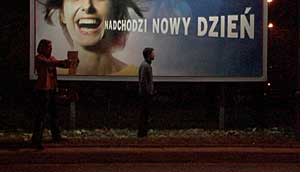 On
the other hand, there are many great comic moments sprinkled throughout,
especially during Lionel and Lucie's misadventures in a new country that
is very foreign to them both. Their deep bond is the crux of Stealth
and their relationship is heartfelt. But the film rambles; it goes on for
way too long and overstays its welcome. The approach is often too serious
when its humor demands broader strokes. Scenes that should be laugh-out
loud funny come across as arid and flat; the film needs to be more over
the top. In fact, plot elements like Lionel's decision to switch sides and
marry can only work if the material is presented as farcical. Director
Baier doesn't quite have Stanley Kubrick's flair for utililizing classical
music as a backdrop and the score by Ravel often sounds pretentious and
doesn't fit the action. Because the tale involves an exploration of Poland,
maybe the music should have been by Chopin? On
the other hand, there are many great comic moments sprinkled throughout,
especially during Lionel and Lucie's misadventures in a new country that
is very foreign to them both. Their deep bond is the crux of Stealth
and their relationship is heartfelt. But the film rambles; it goes on for
way too long and overstays its welcome. The approach is often too serious
when its humor demands broader strokes. Scenes that should be laugh-out
loud funny come across as arid and flat; the film needs to be more over
the top. In fact, plot elements like Lionel's decision to switch sides and
marry can only work if the material is presented as farcical. Director
Baier doesn't quite have Stanley Kubrick's flair for utililizing classical
music as a backdrop and the score by Ravel often sounds pretentious and
doesn't fit the action. Because the tale involves an exploration of Poland,
maybe the music should have been by Chopin? |
|
|
|
|
 |
|
| I enjoy a good horror flick. I hate splatter films with interchangeable and disposable characters who exist only to get killed by a man in a hockey mask with a machete, and don't get me started on "torture porn" like the Hostel films and all those Saw sequels. I like the ones that evoke a creepy mood with style and wit like Stanley Kubrick's The Shining or Roman Polanski's Repulsion or Robert Wise's original version of The Haunting. The Shadows, a new thriller with a transgender twist from Guillermo R. Rodriguez, begins this way but then collapses into complete and incoherent nonsense. | |
|
Ignoring his languishing novel, Stephen goes clubbing with Emmet and his chums and parties until all hours of the night. Suddenly he tires of his book and tells Emmet, "I want out. I don't want my life anymore." With the help of his new friends, he transfers all of his bank accounts and then fakes his death only to discover afterwards that his new comrades are not what they first seemed to be. His life unravels and begins to resemble his fiction. |
|
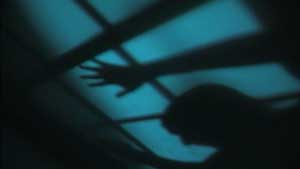 The
Shadows
begins splendidly. Stephen is typing away at his book (which is also called
The Shadows) while he imagines the story that he is writing. The
visuals that depict his germinating tale stylishly spoof horror film conventions
and it is all presented with tongue planted firmly in cheek. The film's
cinematographer has a lot of fun with eerie shadows on the wall that seem
to come to life and the terror-stricken woman in these interludes is played
by the same actor as Stephen - in drag. Stephen is a nerdy and likable guy
who, during a story pitch, pictures his publisher being murdered by the
axe-wielding woman in his story. Many of these interpolations are quite
funny. A humorous and lengthy shot in which he stares at his computer screen,
and dons headphones and dances while throwing his manuscript pages around,
climaxes with the camera tilting to the ceiling and lingering on the shadows
of his waving arms. When he leaves the room to go out for his date with
destiny, a mysterious black shape runs in front of the camera. The
Shadows
begins splendidly. Stephen is typing away at his book (which is also called
The Shadows) while he imagines the story that he is writing. The
visuals that depict his germinating tale stylishly spoof horror film conventions
and it is all presented with tongue planted firmly in cheek. The film's
cinematographer has a lot of fun with eerie shadows on the wall that seem
to come to life and the terror-stricken woman in these interludes is played
by the same actor as Stephen - in drag. Stephen is a nerdy and likable guy
who, during a story pitch, pictures his publisher being murdered by the
axe-wielding woman in his story. Many of these interpolations are quite
funny. A humorous and lengthy shot in which he stares at his computer screen,
and dons headphones and dances while throwing his manuscript pages around,
climaxes with the camera tilting to the ceiling and lingering on the shadows
of his waving arms. When he leaves the room to go out for his date with
destiny, a mysterious black shape runs in front of the camera. |
|
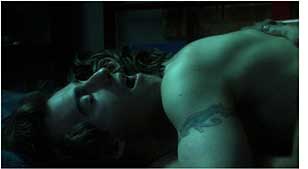 Stephen
gets to enjoy a very hot tryst with Emmet before everything in his life
goes to hell. His transformation into a club kid is plausible but, while
it is impossible to predict the impulsiveness of human behavior, Stephen
seems like too much of a milquetoast to participate in his new friends'
grisly plans. It also isn't clear if closeted homosexuality was the reason
for his divorce and so it is hard to gauge his abrupt attraction to Emmet.
He also seems awfully trusting of these complete strangers when he decides
to stage his demise. As is often the case in such films, nothing is what
it seems. Stephen
gets to enjoy a very hot tryst with Emmet before everything in his life
goes to hell. His transformation into a club kid is plausible but, while
it is impossible to predict the impulsiveness of human behavior, Stephen
seems like too much of a milquetoast to participate in his new friends'
grisly plans. It also isn't clear if closeted homosexuality was the reason
for his divorce and so it is hard to gauge his abrupt attraction to Emmet.
He also seems awfully trusting of these complete strangers when he decides
to stage his demise. As is often the case in such films, nothing is what
it seems. |
|
|
|
|

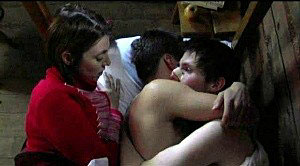 This
is certainly not your conventional queer film, and this is a good thing,
but the deranged road trip that makes up the bulk of
Stealth unfortunately lacks focus. Lionel's motivation
is all over the place. Lionel is a gay man and, no matter how seized
he suddenly is by his newfound Slavic identity, he isn't going to suddenly
turn straight in the process. His impulsive rejection of the man he loves
for a woman (for no other reason than her nationality) is just absurd.
He reconnects with another man while traveling through Poland (and these
scenes are the most enchanting in the film) but this isn't enough to redeem
the movie's cardinal sin.
This
is certainly not your conventional queer film, and this is a good thing,
but the deranged road trip that makes up the bulk of
Stealth unfortunately lacks focus. Lionel's motivation
is all over the place. Lionel is a gay man and, no matter how seized
he suddenly is by his newfound Slavic identity, he isn't going to suddenly
turn straight in the process. His impulsive rejection of the man he loves
for a woman (for no other reason than her nationality) is just absurd.
He reconnects with another man while traveling through Poland (and these
scenes are the most enchanting in the film) but this isn't enough to redeem
the movie's cardinal sin.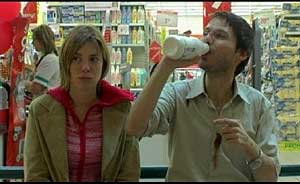 Lionel
is a writer of "autofiction" which he describes as being the "opposite
of autobiography" in that it uses events of his life in order to
create fiction. Because the young director/writer/star assigns his own
name to the main character it is possible that the film is based on events
from his own life but, if that is the case, he desperately needs a dramaturge
or an editor to whip the raw materials into shape. It is clear that Baier
is trying to tie numerous threads and themes together for balance (his
favorite book involves John Sutter's quest for adventure and gold in the
Old West, and his need for a passport in Poland mirrors his prospective
bride's dilemma back in Switzerland) but the glue is missing. This could
have been a wonderfully quirky film but it ultimately taxes the viewer's
patience. It is too confusing and there's not much of a payoff at the
movie's end. The characters possess charm and likability, and this certainly
isn't a bad film; it just could have been so much better.
Lionel
is a writer of "autofiction" which he describes as being the "opposite
of autobiography" in that it uses events of his life in order to
create fiction. Because the young director/writer/star assigns his own
name to the main character it is possible that the film is based on events
from his own life but, if that is the case, he desperately needs a dramaturge
or an editor to whip the raw materials into shape. It is clear that Baier
is trying to tie numerous threads and themes together for balance (his
favorite book involves John Sutter's quest for adventure and gold in the
Old West, and his need for a passport in Poland mirrors his prospective
bride's dilemma back in Switzerland) but the glue is missing. This could
have been a wonderfully quirky film but it ultimately taxes the viewer's
patience. It is too confusing and there's not much of a payoff at the
movie's end. The characters possess charm and likability, and this certainly
isn't a bad film; it just could have been so much better.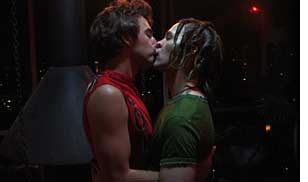 Joe
Lia stars as Stephen Grimes, a horror novelist with writer's block. He
has two weeks to finish his latest book but he has barely started it.
His neurotic live-in sister keeps interrupting him and his ex-wife is
pressuring him to sign divorce papers. One night, while going out for
a drive, he hits a young man with his car and rushes him to the hospital.
The accident victim, Emmet (Emett Allen), coincidentally shares the same
last name as the distraught driver. Emmet recognizes the writer and they
become friends and, shortly after, passionate lovers.
Joe
Lia stars as Stephen Grimes, a horror novelist with writer's block. He
has two weeks to finish his latest book but he has barely started it.
His neurotic live-in sister keeps interrupting him and his ex-wife is
pressuring him to sign divorce papers. One night, while going out for
a drive, he hits a young man with his car and rushes him to the hospital.
The accident victim, Emmet (Emett Allen), coincidentally shares the same
last name as the distraught driver. Emmet recognizes the writer and they
become friends and, shortly after, passionate lovers. 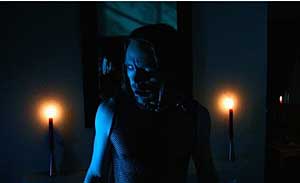 I
wanted to like this film. The first hour is entertaining and, despite
some serious lapses in clarity, becomes quite suspenseful and gripping
in a Twilight Zone vein as Stephen's sense of identity and reality
is stripped away. But then The Shadows
takes a totally whacked-out left turn at Alburquerque and, to be quite
honest, the last fifteen minutes make no sense whatsoever. (The director
is in good company; Polanski's The Tenant was ultimately a study
in style over substance as well.) Twist endings can be fun but this
one is just impossible. Most of the film's characters, primarily Emmet,
appear in the scenes that illustrate his novel-in-progress but this device
fails to provide any explanation for the events that lead up to the finale.
I was reminded of those old Tales From The Darkside episodes on
TV that were notorious for their incoherent conclusions. Writer/director
Rodriguez was clearly aiming for something here, I just don't have a clue
what.
I
wanted to like this film. The first hour is entertaining and, despite
some serious lapses in clarity, becomes quite suspenseful and gripping
in a Twilight Zone vein as Stephen's sense of identity and reality
is stripped away. But then The Shadows
takes a totally whacked-out left turn at Alburquerque and, to be quite
honest, the last fifteen minutes make no sense whatsoever. (The director
is in good company; Polanski's The Tenant was ultimately a study
in style over substance as well.) Twist endings can be fun but this
one is just impossible. Most of the film's characters, primarily Emmet,
appear in the scenes that illustrate his novel-in-progress but this device
fails to provide any explanation for the events that lead up to the finale.
I was reminded of those old Tales From The Darkside episodes on
TV that were notorious for their incoherent conclusions. Writer/director
Rodriguez was clearly aiming for something here, I just don't have a clue
what.