
GAY
FILM REVIEWS BY MICHAEL D. KLEMM


|
||||||
|
GAY
FILM REVIEWS BY MICHAEL D. KLEMM
|
||||||
|
|
|
|
|
|
|
|
Different
From The Others Kino Video, Director: Screenplay: Starring: Unrated, 50 minutes |
The
Birth Of Queer Cinema
Attention all students of queer cinema: what was the first feature film to include a sympathetic gay character and plead for tolerance? Parting Glances? Desert Hearts? Making Love? Victim? Would you believe that the first such cinematic venture was filmed in 1919? |
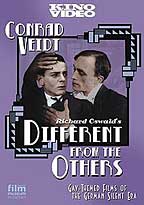
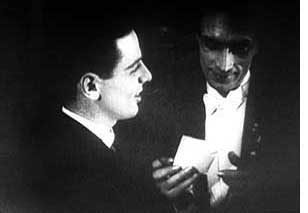 Different
From The Others (Anders Als Die Andern)
was a groundbreaking German silent film that was made during the years of
the Weimar Republic. Aside from presenting the cinema's first gay hero almost
a century ago, Different From The Others
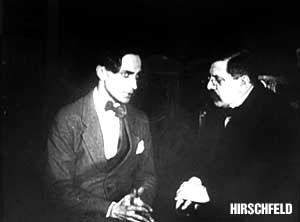
is important historically for a number of reasons. The film was funded,
in part, by Dr. Magnus Hirschfeld's
Institute For Sexual Science. Hirschfeld, whose studies preceded Kinsey's
sex research by several decades, co-wrote and appeared in the film to deliver
an impassioned plea for tolerance and to abolish Paragraph 175 of Germany's
penal code (which made homosexuality illegal). The film's star, Conrad Veidt,
achieved stardom in one of the most famous silent films of all time, The
Cabinet Of Dr. Caligari, the following year. He would go on to work
in Hollywood and cinephiles will remember him from Casablanca. Different
From The Others (Anders Als Die Andern)
was a groundbreaking German silent film that was made during the years of
the Weimar Republic. Aside from presenting the cinema's first gay hero almost
a century ago, Different From The Others
is important historically for a number of reasons. The film was funded,
in part, by Dr. Magnus Hirschfeld's
Institute For Sexual Science. Hirschfeld, whose studies preceded Kinsey's
sex research by several decades, co-wrote and appeared in the film to deliver
an impassioned plea for tolerance and to abolish Paragraph 175 of Germany's
penal code (which made homosexuality illegal). The film's star, Conrad Veidt,
achieved stardom in one of the most famous silent films of all time, The
Cabinet Of Dr. Caligari, the following year. He would go on to work
in Hollywood and cinephiles will remember him from Casablanca. |
|
|
How many films can
you name that come with such a distinguished pedigree? |
|
|
|
|
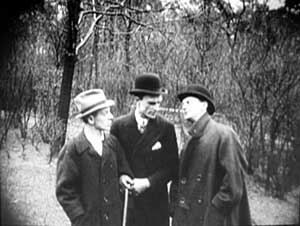 Hirschfeld
is making a political statement but his collaboration with director Richard
Oswald doesn't forget to include a plot. Korner has a young admirer who
comes to all his concerts. Kurt Sivers (Fritz Schulz) is a violin prodigy
who asks the maestro if he can be his student. Kroner becomes his teacher
and more. One day, rather brazenly walking arm in arm in a park, they find
themselves being followed by a sinister looking man. Franz Bollek (Reinhold
Schunzel) is, yes, a blackmailer and soon he is extorting cash from the
terrified violinist. Hirschfeld
is making a political statement but his collaboration with director Richard
Oswald doesn't forget to include a plot. Korner has a young admirer who
comes to all his concerts. Kurt Sivers (Fritz Schulz) is a violin prodigy
who asks the maestro if he can be his student. Kroner becomes his teacher
and more. One day, rather brazenly walking arm in arm in a park, they find
themselves being followed by a sinister looking man. Franz Bollek (Reinhold
Schunzel) is, yes, a blackmailer and soon he is extorting cash from the
terrified violinist. |
|
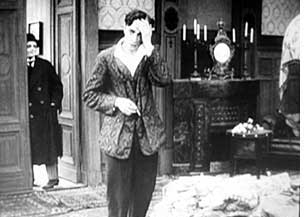 Forgive
me for giving away the ending but it is impossible to discuss the film,
and its influence, otherwise. Besides, I suspect that most would rather
read about this movie than add it to their Netflix queues. When Korner's
young admirer learns about the extortion, he flees. Korner courageously
turns Bollek in to the authorities as a blackmailer and both wind up in
front of a judge. The magistrate is sympathetic to Korner but being queer
is still a crime and he gives him the lightest sentence he can; a week in
jail. Korner is shunned by his friends, and his family tells their son that
there is only one honorable thing left to do. Korner takes poison. And so
our first film sets the template for a long legacy of movies that ended
with the queer offing himself in the last reel. The blackmail plot will
be repeated in 1961's Victim
with Dirk Bogarde. (Both films argue that the anti-homosexual laws accomplish
nothing besides providing blackmailers with a way to make a lucrative living.) Forgive
me for giving away the ending but it is impossible to discuss the film,
and its influence, otherwise. Besides, I suspect that most would rather
read about this movie than add it to their Netflix queues. When Korner's
young admirer learns about the extortion, he flees. Korner courageously
turns Bollek in to the authorities as a blackmailer and both wind up in
front of a judge. The magistrate is sympathetic to Korner but being queer
is still a crime and he gives him the lightest sentence he can; a week in
jail. Korner is shunned by his friends, and his family tells their son that
there is only one honorable thing left to do. Korner takes poison. And so
our first film sets the template for a long legacy of movies that ended
with the queer offing himself in the last reel. The blackmail plot will
be repeated in 1961's Victim
with Dirk Bogarde. (Both films argue that the anti-homosexual laws accomplish
nothing besides providing blackmailers with a way to make a lucrative living.) |
|
 It
is a given that the film can't end happily. No one wrote happy endings for
homosexuals back then (except E.M. Forster but you can't really count him either because
his gay novel with a happy ending, Maurice
(1913), wasn't published until after his death). But Hirschfeld
uses the tragic denouement as a springboard to end the film with one last
ardent speech. Kurt threatens suicide and Hirschfeld begs him to go on living
and to fight the good fight until all homosexuals are free. An obliviously
optimistic pipedream ended the film with Proposition 175 being crossed out
in a large law book. (The statute would not actually get struck down until
1994.) It
is a given that the film can't end happily. No one wrote happy endings for
homosexuals back then (except E.M. Forster but you can't really count him either because
his gay novel with a happy ending, Maurice
(1913), wasn't published until after his death). But Hirschfeld
uses the tragic denouement as a springboard to end the film with one last
ardent speech. Kurt threatens suicide and Hirschfeld begs him to go on living
and to fight the good fight until all homosexuals are free. An obliviously
optimistic pipedream ended the film with Proposition 175 being crossed out
in a large law book. (The statute would not actually get struck down until
1994.) |
|
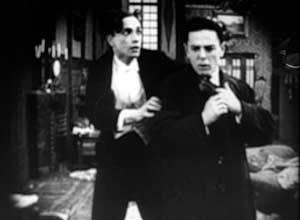
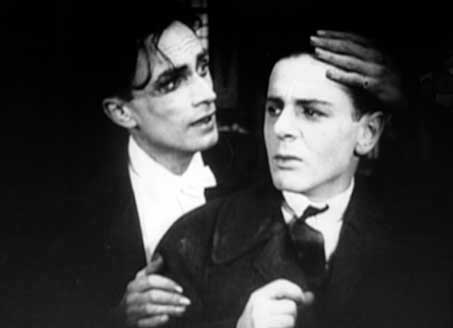
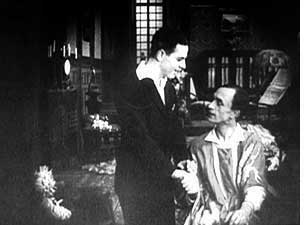 This
was a bold film for 1919 but don't expect to see the two men in bed. The
cues to their relationship are mostly conveyed through glances and gestures.
Kroner will seize the young man's arm and hold it, they stand close and
look at each other, Kroner touches Kurt's hair. It is also apparent in one
scene that they are living together. Veidt delivers an impressive performance
but also plays the role as a limp wristed effete; during the first music
lesson he appears to be wearing a kimono. He's a bit flamboyant but, this
being a silent film, expect the acting to be exaggerated. And the make-up
too. At times Kroner looks like Nosferatu in drag. This
was a bold film for 1919 but don't expect to see the two men in bed. The
cues to their relationship are mostly conveyed through glances and gestures.
Kroner will seize the young man's arm and hold it, they stand close and
look at each other, Kroner touches Kurt's hair. It is also apparent in one
scene that they are living together. Veidt delivers an impressive performance
but also plays the role as a limp wristed effete; during the first music
lesson he appears to be wearing a kimono. He's a bit flamboyant but, this
being a silent film, expect the acting to be exaggerated. And the make-up
too. At times Kroner looks like Nosferatu in drag. |
|
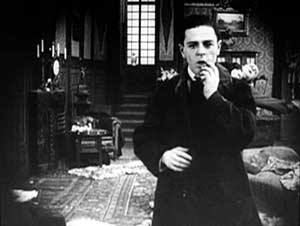 I
admit to cracking up laughing during one scene where I wasn't supposed to.
The blackmailer breaks into Kroner's house and is discovered by Kurt, who
is so distraught when he learns about the extortion that he stands
there in a daze and stares at the camera. When Kroner comes upon them, a
fight ensues. The unintended effect is almost akin to Monty Python or, better
yet, to a Warner Brothers cartoon as the static camera films Kurt still
staring into space while grappling arms and legs flail away behind him. I
admit to cracking up laughing during one scene where I wasn't supposed to.
The blackmailer breaks into Kroner's house and is discovered by Kurt, who
is so distraught when he learns about the extortion that he stands
there in a daze and stares at the camera. When Kroner comes upon them, a
fight ensues. The unintended effect is almost akin to Monty Python or, better
yet, to a Warner Brothers cartoon as the static camera films Kurt still
staring into space while grappling arms and legs flail away behind him. |
|
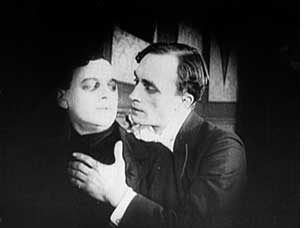 To
modern audiences, silent films often look primitive, stagy and hopelessly
old fashioned. I'll be the first to admit that watching the acting in some
silent films is akin to an evening at Kabuki theatre. And this one
isn't even directed by one of the greats like F.W. Murnau or Fritz Lang.
But cinema was in its infancy and Different
From The Others needs to be looked at through an ideological
prism. The film exists only in fragments but, when you get down to it, what
powerful fragments they are. Look at how this film frightened the horses.
A political statement unheard of in those days, it was so "dangerous"
that Hitler dispatched it in a public bonfire. To
modern audiences, silent films often look primitive, stagy and hopelessly
old fashioned. I'll be the first to admit that watching the acting in some
silent films is akin to an evening at Kabuki theatre. And this one
isn't even directed by one of the greats like F.W. Murnau or Fritz Lang.
But cinema was in its infancy and Different
From The Others needs to be looked at through an ideological
prism. The film exists only in fragments but, when you get down to it, what
powerful fragments they are. Look at how this film frightened the horses.
A political statement unheard of in those days, it was so "dangerous"
that Hitler dispatched it in a public bonfire. |
|
 It's
interesting that most of the fragments that survive are all the gay scenes
that drive the main plot. The secondary storylines involving their disapproving
families are all missing. It's as if someone had taken just the "good parts"
and perhaps held clandestine screenings in the gay cabarets. (By the way,
the film was never shown in America.) Amongst the missing scenes: Kroner's
family tries to fix him up with an heiress; he sends them to Dr. Hirschfeld
to be educated about his homosexuality; Kurt's parents are concerned by
the amount of time their son spends with the older violinist. Kurt's sister
seems as if she may have been an intriguing character. She also falls in
love with Kroner but backs off and becomes their champion when she learns
the truth. It's
interesting that most of the fragments that survive are all the gay scenes
that drive the main plot. The secondary storylines involving their disapproving
families are all missing. It's as if someone had taken just the "good parts"
and perhaps held clandestine screenings in the gay cabarets. (By the way,
the film was never shown in America.) Amongst the missing scenes: Kroner's
family tries to fix him up with an heiress; he sends them to Dr. Hirschfeld
to be educated about his homosexuality; Kurt's parents are concerned by
the amount of time their son spends with the older violinist. Kurt's sister
seems as if she may have been an intriguing character. She also falls in
love with Kroner but backs off and becomes their champion when she learns
the truth. |
|
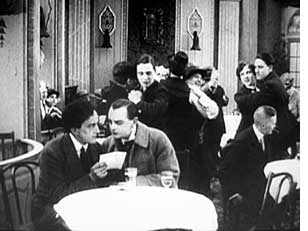 Surviving
scenes include a flashback to Korner's first meeting with Hirschfeld wherein
he is told that he is normal. Korner also remembers going to an ex-gay hypnotist
to be "cured"and waxes nostalgic about a boarding school romance. We also
see male couples dancing in the screen's first gay bar. This scene reportedly
caused a few riots during early screenings. Novelist Christopher
Isherwood offers a firsthand account of seeing the film, as well as a visit to Hirschfeld's
Institute in his memoir, Christopher And His Kind (1976). Surviving
scenes include a flashback to Korner's first meeting with Hirschfeld wherein
he is told that he is normal. Korner also remembers going to an ex-gay hypnotist
to be "cured"and waxes nostalgic about a boarding school romance. We also
see male couples dancing in the screen's first gay bar. This scene reportedly
caused a few riots during early screenings. Novelist Christopher
Isherwood offers a firsthand account of seeing the film, as well as a visit to Hirschfeld's
Institute in his memoir, Christopher And His Kind (1976). |
|
 It's
difficult to judge how the entire film would have played when so much of
it is missing. What survives is amazing. Even more amazing is its rich history.
The onscreen participation of Hirschfeld alone assures its place in the
annals of cinema. For those who are interested in more about Hirschfeld,
a rather forgotten but important figure in the gay pantheon, controversial
German director Rosa
Von Praunheim's 1999 biopic about the pioneer sex researcher, The
Einstein Of Sex, is a good introduction. It's
difficult to judge how the entire film would have played when so much of
it is missing. What survives is amazing. Even more amazing is its rich history.
The onscreen participation of Hirschfeld alone assures its place in the
annals of cinema. For those who are interested in more about Hirschfeld,
a rather forgotten but important figure in the gay pantheon, controversial
German director Rosa
Von Praunheim's 1999 biopic about the pioneer sex researcher, The
Einstein Of Sex, is a good introduction. |
|
|
Different From The Others was remade, again by Oswald and Hirschfeld, in 1927 as The Laws Of Love (Gesette Der Liebe) and no copies of this version are known to survive. Conflicting accounts suggest that footage from Different From The Others may have merely been re-used and incorporated into the newer film and this may account for the truncated version of the film that exists today.
More
on Dr. Magnus Hirschfeld |
 Censorship
wasn't much of an issue during the liberal Weimar era but, a year later,
the film was banned and made available only to medical researchers. All
prints of the film, along with Hirschfeld's research, were burned by the
Nazis when they seized power in the 1930s. The film was thought to have
been lost forever but a partial print was discovered in a Ukraine collector's
vault in 1976. What is left of the film exists only in fragments and the
50 minute version available on DVD attempts to recreate what is missing
through explanatory inter-titles and a handful of existing production
photos.
Censorship
wasn't much of an issue during the liberal Weimar era but, a year later,
the film was banned and made available only to medical researchers. All
prints of the film, along with Hirschfeld's research, were burned by the
Nazis when they seized power in the 1930s. The film was thought to have
been lost forever but a partial print was discovered in a Ukraine collector's
vault in 1976. What is left of the film exists only in fragments and the
50 minute version available on DVD attempts to recreate what is missing
through explanatory inter-titles and a handful of existing production
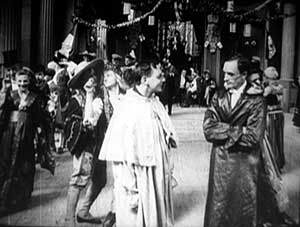
photos.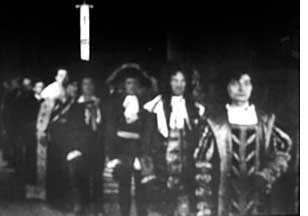 Veidt
stars as Paul Korner, a respected violinist with a secret that could ruin
his career. As the film opens, he is reading the newspaper and is visibly
upset by the accounts of several prominent men who committed suicide.
The news coverage offers no explanations but Korner is able to read between
the lines. He knows all too well how Paragraph 175 hangs over the heads
of every gay man in Germany like "the sword of Damocles." Daydreaming,
he imagines a grand and somber procession of gay historical giants and
the queer queue includes Oscar Wilde, Tchaikovsky and da Vinci.
Veidt
stars as Paul Korner, a respected violinist with a secret that could ruin
his career. As the film opens, he is reading the newspaper and is visibly
upset by the accounts of several prominent men who committed suicide.
The news coverage offers no explanations but Korner is able to read between
the lines. He knows all too well how Paragraph 175 hangs over the heads
of every gay man in Germany like "the sword of Damocles." Daydreaming,
he imagines a grand and somber procession of gay historical giants and
the queer queue includes Oscar Wilde, Tchaikovsky and da Vinci. 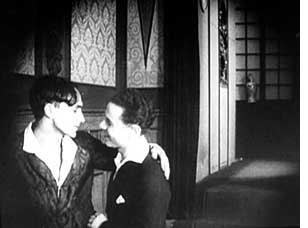 Different
From The Others
was the only film to make such an outright political statement but there
were several other contributions to queer cinema during Germany's Weimar
era. Carl Theodor Dreyer (The Passion Of Joan Of Arc) directed
Mikael (1924), a story of the unrequited love felt by an artist
for the young man who posed for his portrait of Seigfried. 1928's luridly
titled Sex In Chains (Geschlecht In Fesseln) acknowledged that
sex happens between men in prison. This one also concludes with a suicide.
1929's Pandora's Box (Die Buchse der Pandora) by G.W. Pabst featured
the screen's first finely drawn lesbian. Madchen In Uniform (1931)
took place in an all girls boarding school and ended with the obligatory
suicide. Viktor Und Viktoria (1933) would be re-made in 1982 as
Victor/Victoria starring Julie Andrews. Some of these films made
it to America but were heavily censored.
Different
From The Others
was the only film to make such an outright political statement but there
were several other contributions to queer cinema during Germany's Weimar
era. Carl Theodor Dreyer (The Passion Of Joan Of Arc) directed
Mikael (1924), a story of the unrequited love felt by an artist
for the young man who posed for his portrait of Seigfried. 1928's luridly
titled Sex In Chains (Geschlecht In Fesseln) acknowledged that
sex happens between men in prison. This one also concludes with a suicide.
1929's Pandora's Box (Die Buchse der Pandora) by G.W. Pabst featured
the screen's first finely drawn lesbian. Madchen In Uniform (1931)
took place in an all girls boarding school and ended with the obligatory
suicide. Viktor Und Viktoria (1933) would be re-made in 1982 as
Victor/Victoria starring Julie Andrews. Some of these films made
it to America but were heavily censored.