
GAY
FILM REVIEWS BY MICHAEL D. KLEMM


|
||||||
|
GAY
FILM REVIEWS BY MICHAEL D. KLEMM
|
||||||
|
|
|
|
|
|
|
|
Fixing
Frank Director:
Starring:
Unrated, 103 minutes |
My
Analylist Told Me That I Was Right Out Of My Head
Don't get me started on what I think about ex-gay "therapy." Psychologists and ex-gay ministries that believe they can "cure" homosexuality are peddling one of the biggest scams ever perpetrated on the public. Sell us some snake oil or the Brooklyn Bridge while you're at it. Reparative therapy only works when there is something to repair and being gay is not a disease. These charlatans ignore scientific evidence and inflict irreparable damage on the weak and the impressionable. |
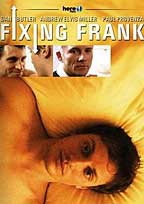
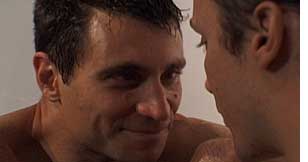 Fixing
Frank
(2002), adapted by Ken Hanes from his stage play and directed by Michael
Selditch, tackles this controversial subject. Frank Johnston (Andrew Elvis
Miller) is a journalist who is tired of writing about tulips and lawn fetes
and is trying his hand at investigative reporting. His psychotherapist boyfriend,
Dr. Jonathan Baldwin (Paul Provenza), has talked him into attending sessions
with Dr. Arthur Apsey (Dan Butler), a psychologist who specializes in "identity
disorder issues." Frank pretends to be a patient who doesn't want to be
gay anymore. Fixing
Frank
(2002), adapted by Ken Hanes from his stage play and directed by Michael
Selditch, tackles this controversial subject. Frank Johnston (Andrew Elvis
Miller) is a journalist who is tired of writing about tulips and lawn fetes
and is trying his hand at investigative reporting. His psychotherapist boyfriend,
Dr. Jonathan Baldwin (Paul Provenza), has talked him into attending sessions
with Dr. Arthur Apsey (Dan Butler), a psychologist who specializes in "identity
disorder issues." Frank pretends to be a patient who doesn't want to be
gay anymore. |
|
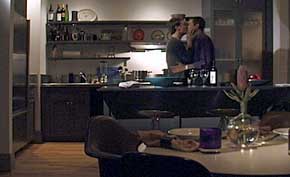 Frank
is hoping to make his reputation by exposing Dr. Apsey as a fraud. Jonathan
is the poster child for gay activism and wants to nail Apsey. He considers
Apsey's approach and the basis of his psychotherapy as "unethical, inappropriate,
immoral" and "perhaps malpractice." He certainly has an axe to grind and
refers to the quack doctor only as "Frankenstein." Because he is also a
psychologist, Jonathan coaches Frank so that he will say the right things
without arousing suspicion. Frank wants to please his partner but is uneasy
with the subterfuge. He is also bothered by his performance during his first
session in Frankenstein's laboratory. "I dripped of self loathing that was
so terrifyingly easy to find in myself," he confesses to Jonathan. "I was
the perfect public service announcement for fag haters." Frank
is hoping to make his reputation by exposing Dr. Apsey as a fraud. Jonathan
is the poster child for gay activism and wants to nail Apsey. He considers
Apsey's approach and the basis of his psychotherapy as "unethical, inappropriate,
immoral" and "perhaps malpractice." He certainly has an axe to grind and
refers to the quack doctor only as "Frankenstein." Because he is also a
psychologist, Jonathan coaches Frank so that he will say the right things
without arousing suspicion. Frank wants to please his partner but is uneasy
with the subterfuge. He is also bothered by his performance during his first
session in Frankenstein's laboratory. "I dripped of self loathing that was
so terrifyingly easy to find in myself," he confesses to Jonathan. "I was
the perfect public service announcement for fag haters." |
|
|
|
|
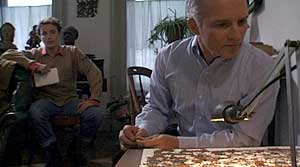 Frank
begins to have doubts about their project and this leads to escalating arguments
with his partner. Frank is feeling vulnerable and, during the next session,
he begins to spill his guts as if he really were the doctor's patient
and not playacting. His conscience gets the best of him and he confesses
the deception to Dr. Apsey. When the doctor orders him to leave, Franks
begs to stay and offers to interview him so that he can tell his side. "I
was talked into things that I wish I hadn't been," Frank bemoans. He explains
that he initially came to be saved - not by him but by the article
he is going to write. "But then you surprised me," he says. "You helped
me." Jonathan is furious, while Frank objects to having to lie in order
to get the truth. Frank
begins to have doubts about their project and this leads to escalating arguments
with his partner. Frank is feeling vulnerable and, during the next session,
he begins to spill his guts as if he really were the doctor's patient
and not playacting. His conscience gets the best of him and he confesses
the deception to Dr. Apsey. When the doctor orders him to leave, Franks
begs to stay and offers to interview him so that he can tell his side. "I
was talked into things that I wish I hadn't been," Frank bemoans. He explains
that he initially came to be saved - not by him but by the article
he is going to write. "But then you surprised me," he says. "You helped
me." Jonathan is furious, while Frank objects to having to lie in order
to get the truth. |
|
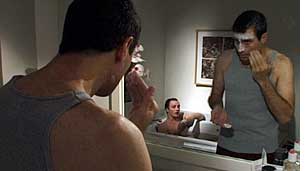 At
about this point, the viewer begins to get the sensation that Jonathan might
be just as manipulative and controlling of Frank as his nemesis, Dr. Frankenstein.
Jonathan wants Apsey to go down and doesn't care about his partner's doubts.
Frank is beginning to feel that Jonathan is using him and Apsey is able
to exploit the young writer's confusion. Apsey's subtle brainwashing efforts
cause Frank to question his six year relationship with Jonathan and, before
long, his sexuality too. Suddenly his very identity is at stake. At
about this point, the viewer begins to get the sensation that Jonathan might
be just as manipulative and controlling of Frank as his nemesis, Dr. Frankenstein.
Jonathan wants Apsey to go down and doesn't care about his partner's doubts.
Frank is beginning to feel that Jonathan is using him and Apsey is able
to exploit the young writer's confusion. Apsey's subtle brainwashing efforts
cause Frank to question his six year relationship with Jonathan and, before
long, his sexuality too. Suddenly his very identity is at stake. |
|
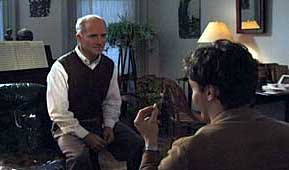 And
so the contest of wills begins. Our hapless hero finds himself a pawn being
manipulated by both Apsey and his partner, and Fixing
Frank becomes a very harrowing psychological mindfuck as
both doctors do battle for Frank's mind. As the cat and mouse games increase
in intensity, Apsey is revealed to be pure evil. You've never seen such
a wolf in sheep's clothing. But, truth be told, Apsey turns into one of
those villains you love to hate - like Nurse Ratched in One Flew Over
The Cuckoo's Nest. Neither Jonathan or Frank fully anticipated how smart
their enemy is and he is a conniving one. When Frank comes back
to interview Apsey, the doctor is ready and his Machiavellian talents really
begin to surface. "You've initiated a game that I'm powerless to terminate,"
he says, "And so I intend to win." He has checked out Frank thoroughly and
knows who his partner is and so, he continues, "Information is strength,
I intend to play your game from a position of strength." He also
begins to systematically place doubts in Frank's mind. ("Has [Jonathan]
never told you that stealing my clients is his favorite pastime?") And
so the contest of wills begins. Our hapless hero finds himself a pawn being
manipulated by both Apsey and his partner, and Fixing
Frank becomes a very harrowing psychological mindfuck as
both doctors do battle for Frank's mind. As the cat and mouse games increase
in intensity, Apsey is revealed to be pure evil. You've never seen such
a wolf in sheep's clothing. But, truth be told, Apsey turns into one of
those villains you love to hate - like Nurse Ratched in One Flew Over
The Cuckoo's Nest. Neither Jonathan or Frank fully anticipated how smart
their enemy is and he is a conniving one. When Frank comes back
to interview Apsey, the doctor is ready and his Machiavellian talents really
begin to surface. "You've initiated a game that I'm powerless to terminate,"
he says, "And so I intend to win." He has checked out Frank thoroughly and
knows who his partner is and so, he continues, "Information is strength,
I intend to play your game from a position of strength." He also
begins to systematically place doubts in Frank's mind. ("Has [Jonathan]
never told you that stealing my clients is his favorite pastime?") |
|
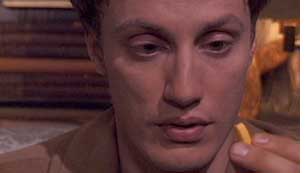 During
one of the film's most frightening scenes, Apsey asks Frank if he would
take a pill that would change him to straight (if such a thing existed)
and asks him to indulge in a hypothetical. He then offers Frank a pill and
uses all of his powers of seduction and persuasion to coax him to swallow
it. Most gay men and women have had moments of indecision, usually when
they are first coming out to themselves, and have wondered if it was possible
to change. But, as Frank so succinctly points out, wondering isn't the same
as wanting. Apsey dares him to take his therapy and prove it doesn't work. During
one of the film's most frightening scenes, Apsey asks Frank if he would
take a pill that would change him to straight (if such a thing existed)
and asks him to indulge in a hypothetical. He then offers Frank a pill and
uses all of his powers of seduction and persuasion to coax him to swallow
it. Most gay men and women have had moments of indecision, usually when
they are first coming out to themselves, and have wondered if it was possible
to change. But, as Frank so succinctly points out, wondering isn't the same
as wanting. Apsey dares him to take his therapy and prove it doesn't work. |
|
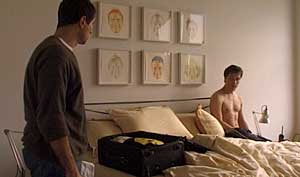 I've
said much but there is more to come and I'll leave it for viewers to discover
the rest of the film on their own. The dialogue is as sharp as surgical
steel and, as Jonathan is quick to remind Frank, words can be as dangerous
as aversion shock therapy. "He will open your skull like cracking an egg,"
he tells Frank, "He will knead your brain like dough until you won't even
remember that you have a penis, let alone what to do with it." This
is certainly a writer's film; who needs action when the talking is this
interesting? Fixing Frank is
a very creepy movie that builds to an intensity that I haven't seen on the
screen in a long time. I've
said much but there is more to come and I'll leave it for viewers to discover
the rest of the film on their own. The dialogue is as sharp as surgical
steel and, as Jonathan is quick to remind Frank, words can be as dangerous
as aversion shock therapy. "He will open your skull like cracking an egg,"
he tells Frank, "He will knead your brain like dough until you won't even
remember that you have a penis, let alone what to do with it." This
is certainly a writer's film; who needs action when the talking is this
interesting? Fixing Frank is
a very creepy movie that builds to an intensity that I haven't seen on the
screen in a long time. |
|
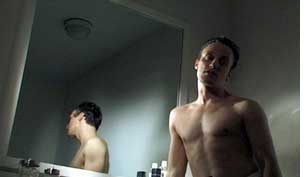 Fixing
Frank's
stage roots are evident but, unlike a lot of online critics, I don't consider
this to be a bad thing. Too many films based on plays, in my opinion, are
ruined by studio insistance that they be "opened up." Look at all those
exquisitely shot Ingmar Bergman films where large chunks consist of two
people sitting in a room inflicting mental pain on each other and then tell
me that isn't cinematic. At least half of Fixing
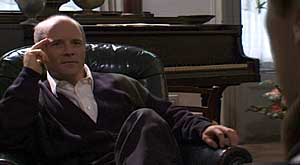
Frank takes place in Dr. Apsey's office lending the proper
air of claustrophobia that is essential for this tale to work. The many
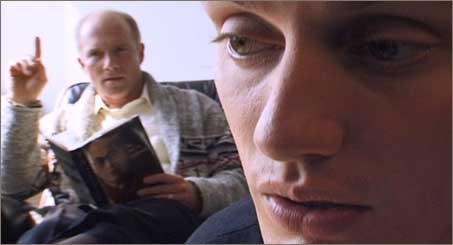
tight close-ups augment the suffocating atmosphere. The film brilliantly
utilizes a common stage device that is rarely used on the screen. When Jonathan
drills Frank on what to say in Frankenstein's office, the director cuts
back and forth between the two locations so that Frank's coaching becomes
part of the dialogue between the doctor and patient. Jonathan will then
begin to appear, even though he isn't really there, in the sessions to coach
and to react negatively to the doctor's subtle machinations. When Frank
is offered the "magic pill," Jonathan is sitting next to him and ordering
him not to take it. Later, when Frank and Jonathan are at each other's throats,
Apsey will appear in these scenes as well to add sarcastic comments. This
technique is brilliant, and often adds much tension breaking humor, and
I refute anyone who gripes that this makes the film "too stagy." Fixing
Frank's
stage roots are evident but, unlike a lot of online critics, I don't consider
this to be a bad thing. Too many films based on plays, in my opinion, are
ruined by studio insistance that they be "opened up." Look at all those
exquisitely shot Ingmar Bergman films where large chunks consist of two
people sitting in a room inflicting mental pain on each other and then tell
me that isn't cinematic. At least half of Fixing
Frank takes place in Dr. Apsey's office lending the proper
air of claustrophobia that is essential for this tale to work. The many
tight close-ups augment the suffocating atmosphere. The film brilliantly
utilizes a common stage device that is rarely used on the screen. When Jonathan
drills Frank on what to say in Frankenstein's office, the director cuts
back and forth between the two locations so that Frank's coaching becomes
part of the dialogue between the doctor and patient. Jonathan will then
begin to appear, even though he isn't really there, in the sessions to coach
and to react negatively to the doctor's subtle machinations. When Frank
is offered the "magic pill," Jonathan is sitting next to him and ordering
him not to take it. Later, when Frank and Jonathan are at each other's throats,
Apsey will appear in these scenes as well to add sarcastic comments. This
technique is brilliant, and often adds much tension breaking humor, and
I refute anyone who gripes that this makes the film "too stagy." |
|
|
See
also: |
 There
is something unsettling about Dr. Apsey's smile from the very first scene.
His demeanor seems pleasing and helpful but he will soon be revealed to
be a master manipulator. Frank doesn't lie very well and his disorientation
is picked up upon by the doctor. Frank, at his partner's urging, has fabricated
a story about a self destructive sex binge but then, in a panic, suddenly
blurts out that he made it all up. Back home, he tells Jonathan "Maybe
it's his eyes, they suck words out of me and everything backfires." He's
befuddled because he is expecting Apsey to tell him that he's bad and
doesn't understand why he doesn't. "He knows you don't trust him," Jonathan
counters, "So he expresses compassion to keep you off balance." If that
was the doctor's intention, he has succeeded. "I think he likes me," Frank
says. "I don't want him to like me."
There
is something unsettling about Dr. Apsey's smile from the very first scene.
His demeanor seems pleasing and helpful but he will soon be revealed to
be a master manipulator. Frank doesn't lie very well and his disorientation
is picked up upon by the doctor. Frank, at his partner's urging, has fabricated
a story about a self destructive sex binge but then, in a panic, suddenly
blurts out that he made it all up. Back home, he tells Jonathan "Maybe
it's his eyes, they suck words out of me and everything backfires." He's
befuddled because he is expecting Apsey to tell him that he's bad and
doesn't understand why he doesn't. "He knows you don't trust him," Jonathan
counters, "So he expresses compassion to keep you off balance." If that
was the doctor's intention, he has succeeded. "I think he likes me," Frank
says. "I don't want him to like me."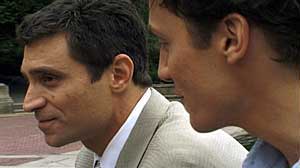 Fixing
Frank
confirms my belief that a big budget isn't necessary to make a compelling
film; all you need is a good script and capable actors. The acting and
the cast's timing, throughout, is superb. Aside from a few bad music cues
near the end, I can find little fault with the film. I have no problems
from a political standpoint either. Apsey may seem, at times, to be treated
with more compassion than he deserves but you will not leave the
film feeling that he is the injured party (unless you're
Fixing
Frank
confirms my belief that a big budget isn't necessary to make a compelling
film; all you need is a good script and capable actors. The acting and
the cast's timing, throughout, is superb. Aside from a few bad music cues
near the end, I can find little fault with the film. I have no problems
from a political standpoint either. Apsey may seem, at times, to be treated
with more compassion than he deserves but you will not leave the
film feeling that he is the injured party (unless you're