
GAY
FILM REVIEWS BY MICHAEL D. KLEMM


|
||||||
|
GAY
FILM REVIEWS BY MICHAEL D. KLEMM
|
||||||
|
|
|
|
|
|
|
|
Proteus Strand
Releasing, Directors/Screenplay: Starring; Unrated, 97 minutes |
Our
Lady Of The Flowers
You would think we were back in the dark ages. As I type these words, Uganda is proposing loathsome legislation that has come to be known as the "Kill the gays" bill. This manifestation of pure hate has made me remember Proteus (2003), a film that I missed on its first release. Proteus, set in 1725, tells the story of two South African prisoners who were executed on sodomy charges. It was co-directed by one of my favorite queer filmmakers, John Greyson (Lilies, Zero Patience). Also sharing the helm is South African gay activist Jack Lewis. The film mixes homophobia, Dutch colonialism, botany and a touch of 20th century Apartheid into an evocative, but ultimately convoluted narrative. |
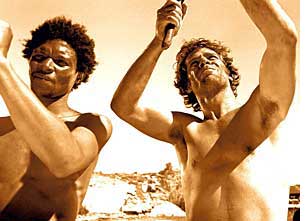 Proteus
is based on historical events. Lewis found the story in old court records
and pitched the idea to Greyson. The setting is the penal colony on Robben
Island, off the coast of Cape Town, South Africa. This is the same prison
where Nelson Mandela was incarcerated for thirty years. Rouxnet Brown stars
as Claas Blank, a native South African. The people of his tribe, the Khoikhoi,
were called Hottentots by the early Dutch settlers and were generally considered
to be subhuman. Claas has been wrongfully imprisoned for stealing back the
horses that were taken from his village by white colonists. His sentence
is ten years of hard labor. Proteus
is based on historical events. Lewis found the story in old court records
and pitched the idea to Greyson. The setting is the penal colony on Robben
Island, off the coast of Cape Town, South Africa. This is the same prison
where Nelson Mandela was incarcerated for thirty years. Rouxnet Brown stars
as Claas Blank, a native South African. The people of his tribe, the Khoikhoi,
were called Hottentots by the early Dutch settlers and were generally considered
to be subhuman. Claas has been wrongfully imprisoned for stealing back the
horses that were taken from his village by white colonists. His sentence
is ten years of hard labor. |
|
|
|
|
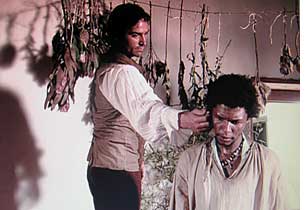 We
soon learn that Virgil is also gay when Jacobz tells Claas that he saw the
botanist cruising the Dutch waterfront back home. Virgil will see the two
men, in a shed by the water tower, enjoying carnal relations and, thereafter,
he gives them the job of fetching water so that they can be alone. Virgil
eventually returns to Amsterdam to publish his findings but is forced to
flee when scores of "sodomites" are arrested and sentenced to death. He
returns to Cape Town and, shortly afterwards, is horrified to find Claas
and Jacobz facing trial - and death - on sodomy charges. We
soon learn that Virgil is also gay when Jacobz tells Claas that he saw the
botanist cruising the Dutch waterfront back home. Virgil will see the two
men, in a shed by the water tower, enjoying carnal relations and, thereafter,
he gives them the job of fetching water so that they can be alone. Virgil
eventually returns to Amsterdam to publish his findings but is forced to
flee when scores of "sodomites" are arrested and sentenced to death. He
returns to Cape Town and, shortly afterwards, is horrified to find Claas
and Jacobz facing trial - and death - on sodomy charges. |
|
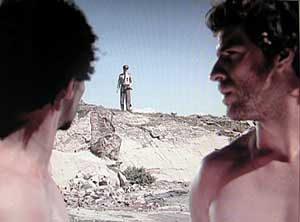 The
directors' hearts were in the right place and Proteus
was made with the best of intentions. There is much here to admire but,
alas, Proteus is one of those
films where the intent surpasses the execution. This is a pity because there
is so much going on in the film. Proteus
is a splendid piece of agitprop; it engages the intellect but fails to ignite
the emotions. However, this is also true of many great films (2001: A
Space Odyssey for example) where the characters are merely pawns in
an ideological stew. This film will confuse the average filmgoer but a close
viewing will reveal a rich tapestry of themes for those who are willing
to make the leap beyond conventional storytelling. The
directors' hearts were in the right place and Proteus
was made with the best of intentions. There is much here to admire but,
alas, Proteus is one of those
films where the intent surpasses the execution. This is a pity because there
is so much going on in the film. Proteus
is a splendid piece of agitprop; it engages the intellect but fails to ignite
the emotions. However, this is also true of many great films (2001: A
Space Odyssey for example) where the characters are merely pawns in
an ideological stew. This film will confuse the average filmgoer but a close
viewing will reveal a rich tapestry of themes for those who are willing
to make the leap beyond conventional storytelling. |
|
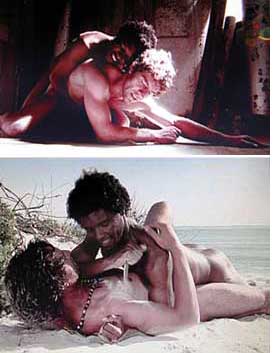 Claas
and Jacobz aren't about to replace Ennis and Jack in Brokeback
Mountain as iconic figures in the queer canon, but they are a very
complex study of male love. Unlike the European invaders who sought control
and dominance by the assigning of new names, our befuddled heroes don't
have, and refuse to accept, a name for what they are. This is hardly a case
of love at first sight or meeting cute. Games of alpha dog dominance transform
slowly into genuine affection over the course of a decade. At first there
is only antagonism. It culminates in Claas taking Jacobz from behind and
it's a scene straight out of Genet.
Is this rape or is this something more? Claas vainly clings to a more traditional
gender role and asserts his masculinity by speaking of a woman "with big
titties" waiting for him back at the village. Jacobz, bearded and butch,
has embraced his queer self and often gazes with longing at his sometimes
indifferent friend. After many years pass, their mutual need will evolve
from mere fucking to something more akin to love. But it isn't until they
are facing death that Claas finally looks at Jacobz with the same love in
his eyes. Claas
and Jacobz aren't about to replace Ennis and Jack in Brokeback
Mountain as iconic figures in the queer canon, but they are a very
complex study of male love. Unlike the European invaders who sought control
and dominance by the assigning of new names, our befuddled heroes don't
have, and refuse to accept, a name for what they are. This is hardly a case
of love at first sight or meeting cute. Games of alpha dog dominance transform
slowly into genuine affection over the course of a decade. At first there
is only antagonism. It culminates in Claas taking Jacobz from behind and
it's a scene straight out of Genet.
Is this rape or is this something more? Claas vainly clings to a more traditional
gender role and asserts his masculinity by speaking of a woman "with big
titties" waiting for him back at the village. Jacobz, bearded and butch,
has embraced his queer self and often gazes with longing at his sometimes
indifferent friend. After many years pass, their mutual need will evolve
from mere fucking to something more akin to love. But it isn't until they
are facing death that Claas finally looks at Jacobz with the same love in
his eyes. |
|
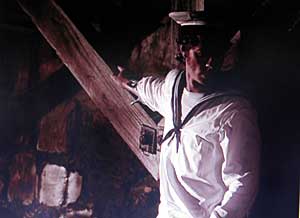 Protea
Cynaroides is the name given to the flowers being studied, and the film
is named after the shapeshifter in Greek mythology. This is important because
the plot dynamics are driven by the theme of shifting sexuality and, most
importantly, shifting public attitudes and mores. A number of flashbacks
depict a Dutch pier where clandestine homosexual pickups are conducted openly
while the authorities seemingly turned a blind eye. Like the raids on 20th
century gay bars, the police probably intervened now and then to make an
occasional example - hence, in all likelihood, Jacobz's arrest. But a public
shift in attitudes leads to a purge. The same happens on the Dutch-ruled
Robben Island and there is a change in the guard at the prison. Claas and
Jacobz's trysts seem to have been ignored for years but now they stand before
a tribunal and their lives are in peril. Such winds of change throughout
history are common. Consider a more modern example: the gay nightlife was
brazenly open and thriving in 1920s Weimar Germany until the Nazis seized
power. Protea
Cynaroides is the name given to the flowers being studied, and the film
is named after the shapeshifter in Greek mythology. This is important because
the plot dynamics are driven by the theme of shifting sexuality and, most
importantly, shifting public attitudes and mores. A number of flashbacks
depict a Dutch pier where clandestine homosexual pickups are conducted openly
while the authorities seemingly turned a blind eye. Like the raids on 20th
century gay bars, the police probably intervened now and then to make an
occasional example - hence, in all likelihood, Jacobz's arrest. But a public
shift in attitudes leads to a purge. The same happens on the Dutch-ruled
Robben Island and there is a change in the guard at the prison. Claas and
Jacobz's trysts seem to have been ignored for years but now they stand before
a tribunal and their lives are in peril. Such winds of change throughout
history are common. Consider a more modern example: the gay nightlife was
brazenly open and thriving in 1920s Weimar Germany until the Nazis seized
power. |
|
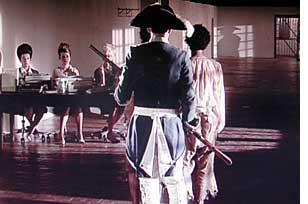 That
such a thing could happen again, and is happening in some parts
of the world, is the heart of Proteus.
Being gay is a crime in many Middle Eastern countries and don't get me started
on what is currently being proposed in Uganda. To drive home how some things
still haven't changed, the directors follow Derek
Jarman and Tom (Swoon) Kalin's
lead and employ deliberate anachronisms to tie their themes to the modern
world. A trio of church ladies recoil in disgust while transcribing the
trial on typewriters. Modern and period dress is employed within the same
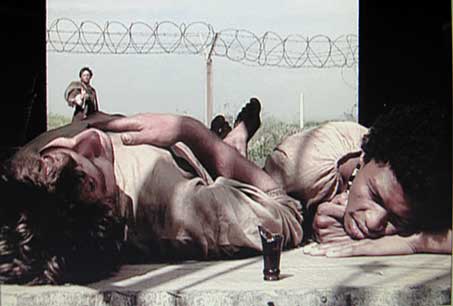
scene. It was problematic to some viewers to see Jeeps, radios and barbed
wire in an 18th century milieu but the filmmakers are obviously making the
same point that Jarman did when he presented gay King Edward II's troops
as ACT UP protesters. That
such a thing could happen again, and is happening in some parts
of the world, is the heart of Proteus.
Being gay is a crime in many Middle Eastern countries and don't get me started
on what is currently being proposed in Uganda. To drive home how some things
still haven't changed, the directors follow Derek
Jarman and Tom (Swoon) Kalin's
lead and employ deliberate anachronisms to tie their themes to the modern
world. A trio of church ladies recoil in disgust while transcribing the
trial on typewriters. Modern and period dress is employed within the same
scene. It was problematic to some viewers to see Jeeps, radios and barbed
wire in an 18th century milieu but the filmmakers are obviously making the
same point that Jarman did when he presented gay King Edward II's troops
as ACT UP protesters. |
|
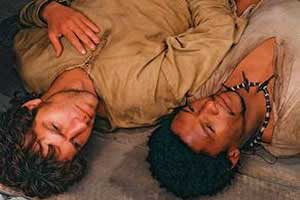 Greyson's
films have always been unconventional. Lilies
(1996) embraced its theatrical roots and created its own reality by having
a group of men in prison play the parts of both genders during a performance
and its subsequent flashbacks. Zero
Patience (1993) used AIDS as the subject for a political musical.
Proteus, like Lilies,
is compelling visually, and a film of rare beauty, but it lacks the cohesion
of his earlier efforts. It is shot on video and it shows. This will turn
off some viewers but the stark, often overexposed photography suggests a
documentary and this works in its favor. The performances are fine. The
multi-lingual film is in Africaans, English, Dutch and Hottentot. For some
reason, a few of the subtitles are in another language and this is needlessly
confusing. The sublime and the clumsy rub shoulders but, even so, it is
still an ambitious and worthwhile film that deserves an audience. Greyson's
films have always been unconventional. Lilies
(1996) embraced its theatrical roots and created its own reality by having
a group of men in prison play the parts of both genders during a performance
and its subsequent flashbacks. Zero
Patience (1993) used AIDS as the subject for a political musical.
Proteus, like Lilies,
is compelling visually, and a film of rare beauty, but it lacks the cohesion
of his earlier efforts. It is shot on video and it shows. This will turn
off some viewers but the stark, often overexposed photography suggests a
documentary and this works in its favor. The performances are fine. The
multi-lingual film is in Africaans, English, Dutch and Hottentot. For some
reason, a few of the subtitles are in another language and this is needlessly
confusing. The sublime and the clumsy rub shoulders but, even so, it is
still an ambitious and worthwhile film that deserves an audience. |
|
|
More
on John Greyson: |
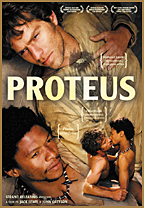
 The
races on Robben Island keep to themselves and everyone avoids "the faggot."
That would be Rijkhaart Jacobz (Neil Sandilands), a moody Dutch sailor
sent away on sodomy charges. Claas initially views Jacobz with contempt
but slowly, over time, the two men will become uneasy friends and then
lovers. Helping to set the forbidden romance in motion is a Dutch botanist
named Virgil Niven (Shaun Smyth) who comes to the island to categorize
the native flora. Claas and Jacobz are amongst the men chosen to assist
him in his work. Claas speaks Dutch and English, as well as his native
tongue, and he becomes a valued assistant when he teaches Virgil the native
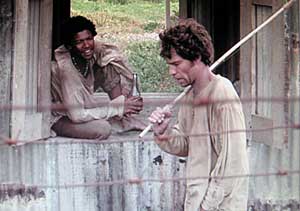
folklore. Claas and Jacobz's work detail allows for many unsupervised
trips to the water tower and, alone, they are free to seize the moment.
Their affair lasts for ten years.
The
races on Robben Island keep to themselves and everyone avoids "the faggot."
That would be Rijkhaart Jacobz (Neil Sandilands), a moody Dutch sailor
sent away on sodomy charges. Claas initially views Jacobz with contempt
but slowly, over time, the two men will become uneasy friends and then
lovers. Helping to set the forbidden romance in motion is a Dutch botanist
named Virgil Niven (Shaun Smyth) who comes to the island to categorize
the native flora. Claas and Jacobz are amongst the men chosen to assist
him in his work. Claas speaks Dutch and English, as well as his native
tongue, and he becomes a valued assistant when he teaches Virgil the native
folklore. Claas and Jacobz's work detail allows for many unsupervised
trips to the water tower and, alone, they are free to seize the moment.
Their affair lasts for ten years.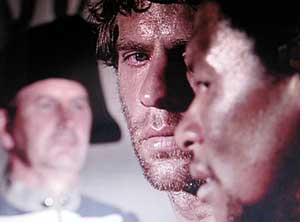 My
own critical judgment may have been compromised because I didn't view
it under the most ideal conditions. The DVD that I rented was scratched
and it got stuck four times while I watched it. Each time this happened,
I was taken out of the movie and its flow might be better than I am giving
it credit for. Period pieces about homophobia like this one are important
and there aren't many of them; only
My
own critical judgment may have been compromised because I didn't view
it under the most ideal conditions. The DVD that I rented was scratched
and it got stuck four times while I watched it. Each time this happened,
I was taken out of the movie and its flow might be better than I am giving
it credit for. Period pieces about homophobia like this one are important
and there aren't many of them; only