|
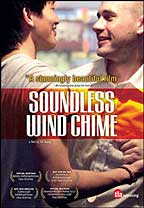
Soundless
Wind Chime
TLA
Releasing,
2009
Director/Screenplay:
Kit Hung
Starring:
Yulai Lu,
Bernhard Bulling,
Wong Siu Ying, Li Fong, Wella Zhang, Hannes Lindenblatt, Gilles Tschudi,
Ruth Schwegler
Unrated,
100 minutes
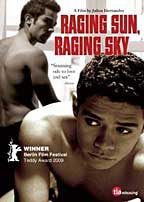
Raging
Sun, Raging Sky
(Rabioso Sol, Rabioso Cielo)
TLA
Releasing,
2009
Director/Screenplay
Julian Hernandez
Starring
Jorge Becerra
Guillermo Villegas
Javier Olivan,
Giovanna Zacan’as, Joaquin Rodriguez, Juan Carlos Torres, Fabian Storniolo,
Harold Torres, Clarissa Rendon
Unrated,
191 minutes
|
Too
Many Notes
by
Michael D. Klemm
Posted online, June 2010
One
of my favorite lines of dialogue ever written appears in both the stage
and screen versions of Peter Shaffer's Amadeus. The director of
Vienna's opera house dismisses Mozart's formidable talent by calling him
"a young man trying to impress beyond his abilities.... too much spice...
too many notes."
Mozart,
of course, was one of the greatest and most innovative young artists who
ever lived. Not every musician can write a symphony when he is eight years
old and, by the same token, not every 20-something filmmaker has the chops
to deliver a Citizen Kane as his debut film. Chinese director Kit
Hung's first feature, Soundless Wind Chime
(2009), is a very poetic movie but, ultimately, suffers from a convoluted
narrative and "too many notes."
|
|
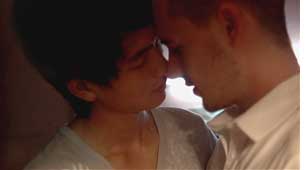 Still,
there is much that I admire about this film. Soundless
Wind Chime is a love story of surprising beauty. The principal
setting is Hong Kong. Ricky (Yulai Lu) is a young man who delivers take-out
food and waits tables for a small restaurant. He shares an apartment with
his Aunt (Wella Zhang), who makes her living as a street prostitute. Ricky
falls in love with a Swiss juggler and pickpocket named Pascal (Bernhard
Bulling). Pascal has run away from an abusive lover and responds to Ricky's
kindness. The two certainly do not "meet cute" in the traditional Hollywood
mode. Pascal picks Ricky's pocket and, when their paths cross again in
the restaurant where Ricky works, he returns the wallet when his former
mark isn't looking. Still,
there is much that I admire about this film. Soundless
Wind Chime is a love story of surprising beauty. The principal
setting is Hong Kong. Ricky (Yulai Lu) is a young man who delivers take-out
food and waits tables for a small restaurant. He shares an apartment with
his Aunt (Wella Zhang), who makes her living as a street prostitute. Ricky
falls in love with a Swiss juggler and pickpocket named Pascal (Bernhard
Bulling). Pascal has run away from an abusive lover and responds to Ricky's
kindness. The two certainly do not "meet cute" in the traditional Hollywood
mode. Pascal picks Ricky's pocket and, when their paths cross again in
the restaurant where Ricky works, he returns the wallet when his former
mark isn't looking.
|
|
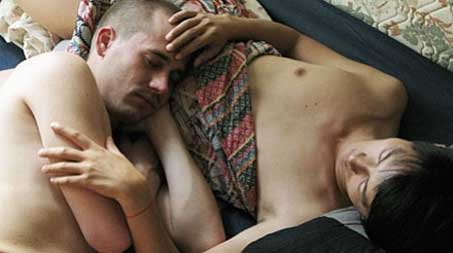
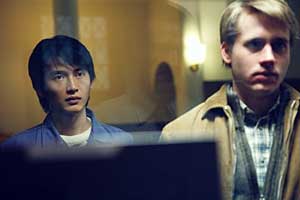 Their
relationship is depicted through a series of episodes that, while not
rendering the complete picture, resonate as exquisitely realized sketches.
These scenes provide the film's emotional heft. We learn, eventually,
that these scenes are flashbacks. Pascal has died in a traffic accident
and Ricky has traveled to Pascal's native Switzerland to search for his
late lover's roots. Midway into the film, he meets a young antique dealer
named Ueli (also played by Bulling) who looks like his beloved, and they
also fall in love. This framing story, which is under-developed compared
to the flashbacks, creates unnecessary confusion and its complications
become even more twisted when a third storyline is introduced in which
Ricky visits his dying Mother in Bejing. Their
relationship is depicted through a series of episodes that, while not
rendering the complete picture, resonate as exquisitely realized sketches.
These scenes provide the film's emotional heft. We learn, eventually,
that these scenes are flashbacks. Pascal has died in a traffic accident
and Ricky has traveled to Pascal's native Switzerland to search for his
late lover's roots. Midway into the film, he meets a young antique dealer
named Ueli (also played by Bulling) who looks like his beloved, and they
also fall in love. This framing story, which is under-developed compared
to the flashbacks, creates unnecessary confusion and its complications
become even more twisted when a third storyline is introduced in which
Ricky visits his dying Mother in Bejing.
|
|
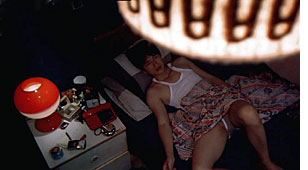 There
are no clear-set rules when making a film. Many international directors
are renowned for throwing conventional narrative out the window and developing
new visual languages. But Kit Hung is a new director and needs to hone
his skills a bit more before tackling something this ambitious. Much of
this film is quite beautiful to behold but parts of it are also incomprehensible
on a first viewing. This isn't Finnegans Wake by James Joyce, an
opus that readers tackle because of its difficulties, and more
clarity is called for. Even so, I found Hung's rendering of the central
love story to be visual poetry at its best. Most of the narrative was
clear when I watched it a second time, but the symbolism employed in its
opening and closing moments continues to elude me. There
are no clear-set rules when making a film. Many international directors
are renowned for throwing conventional narrative out the window and developing
new visual languages. But Kit Hung is a new director and needs to hone
his skills a bit more before tackling something this ambitious. Much of
this film is quite beautiful to behold but parts of it are also incomprehensible
on a first viewing. This isn't Finnegans Wake by James Joyce, an
opus that readers tackle because of its difficulties, and more
clarity is called for. Even so, I found Hung's rendering of the central
love story to be visual poetry at its best. Most of the narrative was
clear when I watched it a second time, but the symbolism employed in its
opening and closing moments continues to elude me.
|
|
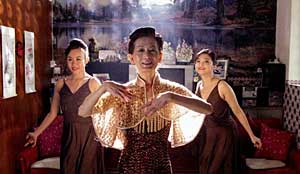 A
non-linear story, in itself, is not a bad thing, but this is where my
"too many notes" analogy comes into play. Hung likes to insert speeded-up
interludes, and often plays with even flashier techniques, for no apparent
reason. There is a bizarre, though entertaining, sequence in which Ricky
delivers food to a disabled old woman's home. Suddenly it's fantasy sequence
time ala American Beauty or Six
Feet Under and the old woman is wearing a glittering, dance hall
dress and sashaying around the apartment with a pair of younger back-up
dancers. The scene is both funny and charming but I have no idea what
it had to do with anything - and there are no similar episodes in the
film. A
non-linear story, in itself, is not a bad thing, but this is where my
"too many notes" analogy comes into play. Hung likes to insert speeded-up
interludes, and often plays with even flashier techniques, for no apparent
reason. There is a bizarre, though entertaining, sequence in which Ricky
delivers food to a disabled old woman's home. Suddenly it's fantasy sequence
time ala American Beauty or Six
Feet Under and the old woman is wearing a glittering, dance hall
dress and sashaying around the apartment with a pair of younger back-up
dancers. The scene is both funny and charming but I have no idea what
it had to do with anything - and there are no similar episodes in the
film.
|
|
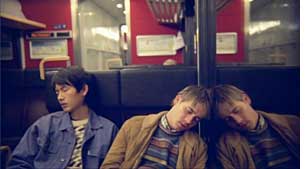 Writing
about foreign cinema has its challenges. I'm sure there are numerous cultural
references that went over my head that would have been taken for granted
by Hung's native audience. Chinese folklore appears to be an important
element and the director's notes on the official site explain that the
Chinese believe that a soul returns home on the seventh day after his
death. Because the time frames are impossible to discern, I am unsure
when Ricky arrives in Switzerland. Is it a week later and does he look
upon Ueli as Pascal's reincarnation? Is this the reason why they both
look so troubled when they first see each other in a bar? Is the director
trying to invoke Hitchcock's
Vertigo? Writing
about foreign cinema has its challenges. I'm sure there are numerous cultural
references that went over my head that would have been taken for granted
by Hung's native audience. Chinese folklore appears to be an important
element and the director's notes on the official site explain that the
Chinese believe that a soul returns home on the seventh day after his
death. Because the time frames are impossible to discern, I am unsure
when Ricky arrives in Switzerland. Is it a week later and does he look
upon Ueli as Pascal's reincarnation? Is this the reason why they both
look so troubled when they first see each other in a bar? Is the director
trying to invoke Hitchcock's
Vertigo?
|
|
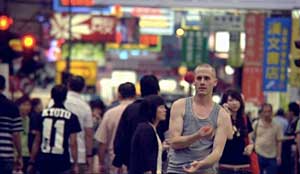 I've
been thinking about another film - one of my favorite queer titles actually
- that employs a similar "everything but the kitchen sink" style and that's
Jon Shear's Urbania.
In that film, Dan Futterman is having a bit of a meltdown after losing
his partner while all these urban legends come to life around him. I think
the film is brilliant but I am wondering now how it would play in another
country that doesn't share our folklore. Would Chinese audiences wonder
why an old lady is putting her wet poodle in a microwave? Am I clueless,
for the same reason, about stuff that would be obvious to Hung's peers? I've
been thinking about another film - one of my favorite queer titles actually
- that employs a similar "everything but the kitchen sink" style and that's
Jon Shear's Urbania.
In that film, Dan Futterman is having a bit of a meltdown after losing
his partner while all these urban legends come to life around him. I think
the film is brilliant but I am wondering now how it would play in another
country that doesn't share our folklore. Would Chinese audiences wonder
why an old lady is putting her wet poodle in a microwave? Am I clueless,
for the same reason, about stuff that would be obvious to Hung's peers?
|
|
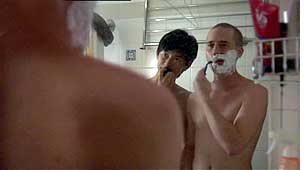 Even
though he really needs to learn when less is more, and also when to employ
a dramaturge, Hung is a gifted director and worth watching. He has a special
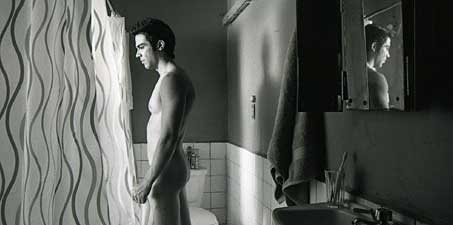
talent for crafting idyllic memories. A scene where Ricky gazes in a mirror,
while shaving with an electric razor, triggers tender and erotic thoughts
of giving Pascal a haircut while the sound of the buzzing clippers ties
the past to the present. Ditto for when Ricky flashes back to a very sexy
and romantic reverie of Pascal shaving Ricky's upper lip with his disposable
razor and then sealing it with a kiss. The scene is subtle, sexy and sweet,
as was the barber daydream. Even
though he really needs to learn when less is more, and also when to employ
a dramaturge, Hung is a gifted director and worth watching. He has a special
talent for crafting idyllic memories. A scene where Ricky gazes in a mirror,
while shaving with an electric razor, triggers tender and erotic thoughts
of giving Pascal a haircut while the sound of the buzzing clippers ties
the past to the present. Ditto for when Ricky flashes back to a very sexy
and romantic reverie of Pascal shaving Ricky's upper lip with his disposable
razor and then sealing it with a kiss. The scene is subtle, sexy and sweet,
as was the barber daydream.
|
|
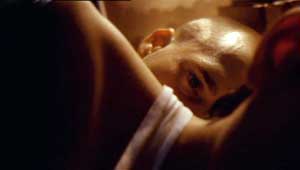 At
the same time, Hung is equally adept at showing their relationship deteriorate.
An un-eaten dinner is plunged into darkness as a light turns off. A cellphone
isn't answered. Pascal cruises another man on a bus. Following a quarrel,
Pascal reaches out to stop Ricky from leaving and grabs his arm with a
mixture of ferocity and longing that is jolting. These scenes balance
the ones with too many notes. The human form is celebrated and love scenes
are landscapes of body parts. Two scenes, that are quite explicit sexually,
are actually used to establish character and are far from gratuitous.
The use of music and natural sound is inspired. The score often consists
of only a few notes of minimalist piano, its simplicity and style invoking
Philip Glass with a Far East flavor. Sound and vision are a mix of Western
and Eastern conventions. At
the same time, Hung is equally adept at showing their relationship deteriorate.
An un-eaten dinner is plunged into darkness as a light turns off. A cellphone
isn't answered. Pascal cruises another man on a bus. Following a quarrel,
Pascal reaches out to stop Ricky from leaving and grabs his arm with a
mixture of ferocity and longing that is jolting. These scenes balance
the ones with too many notes. The human form is celebrated and love scenes
are landscapes of body parts. Two scenes, that are quite explicit sexually,
are actually used to establish character and are far from gratuitous.
The use of music and natural sound is inspired. The score often consists
of only a few notes of minimalist piano, its simplicity and style invoking
Philip Glass with a Far East flavor. Sound and vision are a mix of Western
and Eastern conventions.
|
|
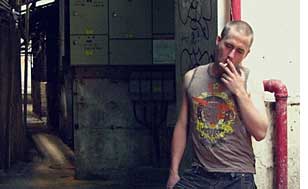 Soundless
Wind Chime
is a film that requires a bit of work from its audience. Some viewers
will be intrigued, others will be irritated. If you're willing to go with
the flow, it's a rewarding movie. Its pleasures are intellectual, emotional
and carnal. Hung certainly knows how to think outside the box. He spent
five years making Soundless Wind Chime;
some of that was overkill but some of that was also time well spent. You'll
find romance, you'll find heartache, you'll find confusing mysticism.
Too many notes perhaps, but a diamond in the rough. I hope this isn't
the last we hear from this young filmmaker. Soundless
Wind Chime
is a film that requires a bit of work from its audience. Some viewers
will be intrigued, others will be irritated. If you're willing to go with
the flow, it's a rewarding movie. Its pleasures are intellectual, emotional
and carnal. Hung certainly knows how to think outside the box. He spent
five years making Soundless Wind Chime;
some of that was overkill but some of that was also time well spent. You'll
find romance, you'll find heartache, you'll find confusing mysticism.
Too many notes perhaps, but a diamond in the rough. I hope this isn't
the last we hear from this young filmmaker.
|
 |
|
Raging
Sun, Raging Sky (Rabioso Sol, Rabioso Cielo)
won the Teddy Award at 2009's Berlin International Film Festival. From
Mexican director Julian Hernandez, it is an exquisitely filmed celebration
of male camaraderie, lust and love set in both urban and mythological
milieus. Unfortunately, this one also suffers from way too many notes
and a confusing script. It is as ambiguous as it is ambitious.
|
|
 Calling
this film "experimental" is an understatement. Its plot defies easy description
but I'm going to give it a shot. The movie is advertised on the DVD's
box as being the passionate love story between two young Mexican guys
named Ryo and Kieri. For reasons that baffle me, the film opens with an
"artsy" ten minute sequence devoted to an un-named woman who is wandering
the city streets in a daze while a symphony of urban voices rings in her
ears. Caught in a rain storm, she connects with a stranger named Ryo (Guillermo
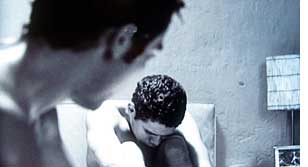
Villegas). They go back to his apartment and enjoy a lengthy sex scene
together. Afterwards, she says to her sleeping lover, "There will come
a powerful mate for you. Like a slice of heaven, his vigor will be great.
Perfect, magnificent. Meet with him. It's in your hands. Do not fear.
Go forth and free the world from this disgrace." Then, like a ghost, she
vanishes from both his room and from the rest of the film. Calling
this film "experimental" is an understatement. Its plot defies easy description
but I'm going to give it a shot. The movie is advertised on the DVD's
box as being the passionate love story between two young Mexican guys
named Ryo and Kieri. For reasons that baffle me, the film opens with an
"artsy" ten minute sequence devoted to an un-named woman who is wandering
the city streets in a daze while a symphony of urban voices rings in her
ears. Caught in a rain storm, she connects with a stranger named Ryo (Guillermo
Villegas). They go back to his apartment and enjoy a lengthy sex scene
together. Afterwards, she says to her sleeping lover, "There will come
a powerful mate for you. Like a slice of heaven, his vigor will be great.
Perfect, magnificent. Meet with him. It's in your hands. Do not fear.
Go forth and free the world from this disgrace." Then, like a ghost, she
vanishes from both his room and from the rest of the film.
|
|
 From
here, the action moves to a porn theater where a succession of men enjoy
clandestine sex in the lavatory. The other two principal players are introduced;
both will become rivals for Ryo's affection. Kieri (Jorge Becerra) is
a handsome young man who will fulfill the hero role foretold by that mysterious
woman. Tari (Javier Olivan) is a piece of rough trade who also wants Ryo
for himself. Each of the three men has a series of sexual adventures during
the film's middle. Tari begins to stalk Ryo, and he becomes jealous when
Ryo and Kieri go home together. The film's final third enters the world
of dreams and myths. Tari kidnaps Ryo and keeps him captive in an underground
cave. Echoing ancient legends like the quest of Orpheus for Eurydice,
Kieri sets off into an arid wilderness to rescue his lost love. From
here, the action moves to a porn theater where a succession of men enjoy
clandestine sex in the lavatory. The other two principal players are introduced;
both will become rivals for Ryo's affection. Kieri (Jorge Becerra) is
a handsome young man who will fulfill the hero role foretold by that mysterious
woman. Tari (Javier Olivan) is a piece of rough trade who also wants Ryo
for himself. Each of the three men has a series of sexual adventures during
the film's middle. Tari begins to stalk Ryo, and he becomes jealous when
Ryo and Kieri go home together. The film's final third enters the world
of dreams and myths. Tari kidnaps Ryo and keeps him captive in an underground
cave. Echoing ancient legends like the quest of Orpheus for Eurydice,
Kieri sets off into an arid wilderness to rescue his lost love.
|
|
 Aside
from a foreshadowing dream that both Ryo and Tari wake up from at different
parts of the film, the fantasy in the third act comes out of nowhere.
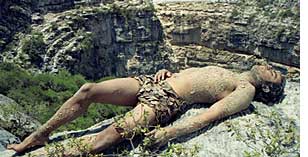
The film shifts from black & white to bleached out color. Shot in the
desert, with lots of full frontal nudity, it's as if we suddenly are in
Derek Jarman's Sebastiane
or something by Pasolini. The film really goes over the top at
this point when Kieri is helped on his journey to rescue Ryo by a benevolent
female spirit. She also repeats the vague phrase, "Go forth and free
the world from this disgrace." Our hero literally breaks out from under
the dry earth as if being reborn and then, almost naked and caked in dried
and cracked mud, searches for his beloved. This final act plays as if
erotic photographers Bruce Weber or Herb Ritts were adapting Carlos Castenada's mystical books
to the screen. Aside
from a foreshadowing dream that both Ryo and Tari wake up from at different
parts of the film, the fantasy in the third act comes out of nowhere.
The film shifts from black & white to bleached out color. Shot in the
desert, with lots of full frontal nudity, it's as if we suddenly are in
Derek Jarman's Sebastiane
or something by Pasolini. The film really goes over the top at
this point when Kieri is helped on his journey to rescue Ryo by a benevolent
female spirit. She also repeats the vague phrase, "Go forth and free
the world from this disgrace." Our hero literally breaks out from under
the dry earth as if being reborn and then, almost naked and caked in dried
and cracked mud, searches for his beloved. This final act plays as if
erotic photographers Bruce Weber or Herb Ritts were adapting Carlos Castenada's mystical books
to the screen.
|
|
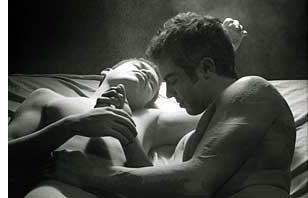 Raging
Sun, Raging Sky
is reportedly the third installment in a trilogy of related films, each
involving young gay lovers, that includes A Thousand Clouds Of Peace
(2003) and Broken Sky (2006). The photography (most of it in black
and white) is beautiful. The director certainly has an eye for the image
and virtually any frame of this film could be enlarged to hang in an art
gallery. A feast for the senses, the film looks and sounds great. I can
honestly say that I haven't been there and done that with this art flick.
But the script is nearly non-existent. There is almost no dialogue in
the film, making 2001: A Space Odyssey sound wordy in comparison.
I've championed many oddball films over the years, some even more unusual
than this one. But those films were short and this one is over
three hours long! Even an old art film junkie like me still requires at
least some narrative if I have to sit through a film this long. Raging
Sun, Raging Sky
is reportedly the third installment in a trilogy of related films, each
involving young gay lovers, that includes A Thousand Clouds Of Peace
(2003) and Broken Sky (2006). The photography (most of it in black
and white) is beautiful. The director certainly has an eye for the image
and virtually any frame of this film could be enlarged to hang in an art
gallery. A feast for the senses, the film looks and sounds great. I can
honestly say that I haven't been there and done that with this art flick.
But the script is nearly non-existent. There is almost no dialogue in
the film, making 2001: A Space Odyssey sound wordy in comparison.
I've championed many oddball films over the years, some even more unusual
than this one. But those films were short and this one is over
three hours long! Even an old art film junkie like me still requires at
least some narrative if I have to sit through a film this long.
|
|
 We
learn virtually nothing about these characters. We see Kieri working
in a call center, Ryo waiting tables, and Tari training as a boxer. We
do know everything about their sex lives however because this is pretty
much all we see for at least half of the film's 191 minute runtime. All
three members of the triangle do it at least once in a public place. Even
though their love is supposed to be the engine that drives this film,
Ryo and Kieri don't meet until almost two hours have passed. We're treated
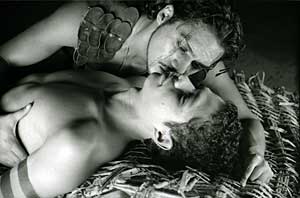
then to a lengthy series of beautifully filmed kissing and sex scenes
between the two men. With the camera spinning around them ala Hitchcock's
Vertigo, they share the most kisses of all the dramatis personae.
Some of the men, encountered in the johns and in the streets, pull away
from a kiss and push the other man's head down crotch-wards instead. Sometimes
things even turn violent; Tari, unable to have Ryo, assaults a man who
comes on to him. An air of menace is introduced when Tari stands in the
pouring rain looking up at Ryo's window, having followed the lovers home.
Ryo and Kieri are hot together but, because there is no dialogue between
them, they are strangers to us. All we know is that they have great sex. We
learn virtually nothing about these characters. We see Kieri working
in a call center, Ryo waiting tables, and Tari training as a boxer. We
do know everything about their sex lives however because this is pretty
much all we see for at least half of the film's 191 minute runtime. All
three members of the triangle do it at least once in a public place. Even
though their love is supposed to be the engine that drives this film,
Ryo and Kieri don't meet until almost two hours have passed. We're treated
then to a lengthy series of beautifully filmed kissing and sex scenes
between the two men. With the camera spinning around them ala Hitchcock's
Vertigo, they share the most kisses of all the dramatis personae.
Some of the men, encountered in the johns and in the streets, pull away
from a kiss and push the other man's head down crotch-wards instead. Sometimes
things even turn violent; Tari, unable to have Ryo, assaults a man who
comes on to him. An air of menace is introduced when Tari stands in the
pouring rain looking up at Ryo's window, having followed the lovers home.
Ryo and Kieri are hot together but, because there is no dialogue between
them, they are strangers to us. All we know is that they have great sex.
|
|
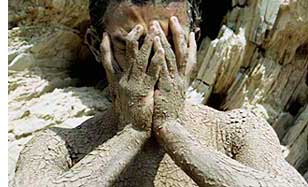 So,
the plot mostly consists of anonymous sex in lavatories, movie theater
hallways, alleys and bedrooms before the film really takes a left turn
at Alburquerque in the last hour. This is not to say that these scenes
aren't interesting; Hernandez has a talent for transforming mundane sex
acts into compelling drama. Despite the seedy settings, the men seem warm
and affectionate and just looking for a bit of love in a cold urban world.
Visual symbols seem to connect the film's various sections. The cracked
mud clinging to our hero during the final quest mimics the peeling paint
on the walls in the johns and the movie theater. What propels this into
the land of myth, however, is a riddle that I can't answer. Raging
Sun, Raging Sky seems to be a celebration of the Elementals,
primarily earth, water and sky. The sun is a prominent symbol. There is
a lot going on in this movie and it is probably my own ignorance of Mexican
mythology that prevents me from seeing the entire picture. Rain seems
to be an important metaphor and, at the climax, a teardrop turns into
a stream running down a dry mountain. Both Kieri and Tari plunge their
faces into a sink filled with water at climactic moments and find themselves
swimming after Ryo as he beckons for them to follow. So,
the plot mostly consists of anonymous sex in lavatories, movie theater
hallways, alleys and bedrooms before the film really takes a left turn
at Alburquerque in the last hour. This is not to say that these scenes
aren't interesting; Hernandez has a talent for transforming mundane sex
acts into compelling drama. Despite the seedy settings, the men seem warm
and affectionate and just looking for a bit of love in a cold urban world.
Visual symbols seem to connect the film's various sections. The cracked
mud clinging to our hero during the final quest mimics the peeling paint
on the walls in the johns and the movie theater. What propels this into
the land of myth, however, is a riddle that I can't answer. Raging
Sun, Raging Sky seems to be a celebration of the Elementals,
primarily earth, water and sky. The sun is a prominent symbol. There is
a lot going on in this movie and it is probably my own ignorance of Mexican
mythology that prevents me from seeing the entire picture. Rain seems
to be an important metaphor and, at the climax, a teardrop turns into
a stream running down a dry mountain. Both Kieri and Tari plunge their
faces into a sink filled with water at climactic moments and find themselves
swimming after Ryo as he beckons for them to follow.
|
|
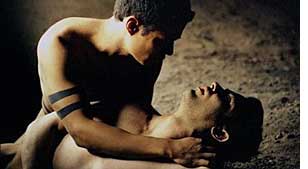 The
director's use of sound equals his mastery of the image. The quest sequence
is a subtle symphony of chants, drones and Hellenic sounding percussion.
Many scenes also play out in silence, heightening the realism. There is
no dialogue between the principals, only an occasional phrase like "In
the water, the loved one can be seen" repeating in Kieri's head like a
mantra, or a stray song lyric on the radio, or a voice on the television.
The camera is allowed to do most of the talking, often inducing vertigo
as it pans in a circle from one actor to another. I've re-visited a few
scenes since I started writing this review and they grow richer with repeated
viewings. The film almost works better watched in fragments. I find myself
using that word "poetry" again. The
director's use of sound equals his mastery of the image. The quest sequence
is a subtle symphony of chants, drones and Hellenic sounding percussion.
Many scenes also play out in silence, heightening the realism. There is
no dialogue between the principals, only an occasional phrase like "In
the water, the loved one can be seen" repeating in Kieri's head like a
mantra, or a stray song lyric on the radio, or a voice on the television.
The camera is allowed to do most of the talking, often inducing vertigo
as it pans in a circle from one actor to another. I've re-visited a few
scenes since I started writing this review and they grow richer with repeated
viewings. The film almost works better watched in fragments. I find myself
using that word "poetry" again.
|
|
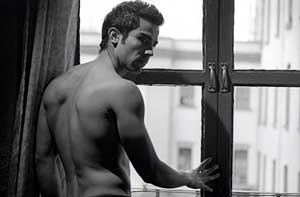 Like
Soundless Wind Chime, this one suffers from a lot of overkill too.
Films like this are difficult to review. I applaud films that deviate
from the norm but filmmakers need an audience; one's work can be personal
but the line needs to be drawn before it becomes self indulgence. Express
your art, but also give your audience enough clues so they can understand
it. Regrettably, today's generation of moviegoers don't have the patience
that allowed films like 2001 to flourish in the 60s. But Raging
Sun, Raging Sky is the work of a master visualist; there
is too much artistry for me to dismiss this unorthodox movie. It's obviously
not for everyone. Those who demand a conventional plot with a defined
beginning, middle and end will lose patience. Those who like to take a
walk on the wild side, while being continually exposed to lots of hot
men engaged in carnal pleasures, will be more open to the experience.
But, seriously, did it have to be over three hours long? Like
Soundless Wind Chime, this one suffers from a lot of overkill too.
Films like this are difficult to review. I applaud films that deviate
from the norm but filmmakers need an audience; one's work can be personal
but the line needs to be drawn before it becomes self indulgence. Express
your art, but also give your audience enough clues so they can understand
it. Regrettably, today's generation of moviegoers don't have the patience
that allowed films like 2001 to flourish in the 60s. But Raging
Sun, Raging Sky is the work of a master visualist; there
is too much artistry for me to dismiss this unorthodox movie. It's obviously
not for everyone. Those who demand a conventional plot with a defined
beginning, middle and end will lose patience. Those who like to take a
walk on the wild side, while being continually exposed to lots of hot
men engaged in carnal pleasures, will be more open to the experience.
But, seriously, did it have to be over three hours long?
|



