
GAY
FILM REVIEWS BY MICHAEL D. KLEMM


|
||||||
|
GAY
FILM REVIEWS BY MICHAEL D. KLEMM
|
||||||
|
|
|
|
|
|
|
|
Fox
And His Friends 1975 Director:: Screenplay: Starring: Rainer Werner Fassbinder, Peter Chatel, Karlheinz Bšhm, Adrian Hoven, Christiane Maybach, Harry Baer, Hans Zander, Kurt Raab Unrated, 123 minutes
In
A Year Of 13 Moons Director/Screenplay: Starring: Volker Spengler, Ingrid Caven, Gottfried John, Saitz Elisabeth Trissenaar, Eva Mattes, GŸnther Kaufmann, Lilo Pempeit, Isolde Barth, Karl Scheydt Unrated, 124 minutes
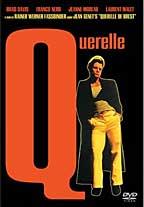
Querelle Director:: Screenplay: Starring: Brad Davis, Franco Nero, Jeanne Moreau, Laurent Malet, Hanno Pšschl, GŸnther Kaufmann, Burkhard Driest, Roger Fritz, Dieter Schidor Unrated, 108 minutes
|
Cinema
of the Absurd
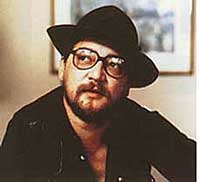
The late Rainer Werner Fassbinder, along with Werner Herzog and Volker Schlondorff, re-defined German cinema in the 1970s. Fassbinder directed 43 features between 1965 and 1982, including Berlin Alexanderplatz, a 16 hour miniseries for German television, and these films range from brilliant to awful.He surrounded himself with a circle of bohemian artists and actors, not unlike Andy Warhol's Factory during the 1960s. Though twice married, he was also openly gay. Fassbinder was a tortured soul who directed film after film to escape his own loneliness. By turns generous and abusive, he reportedly drove two male lovers to suicide while he slid into an abyss of extravagant drug use. He was only 36 when he died of a drug overdose (some say suicide) in 1982.
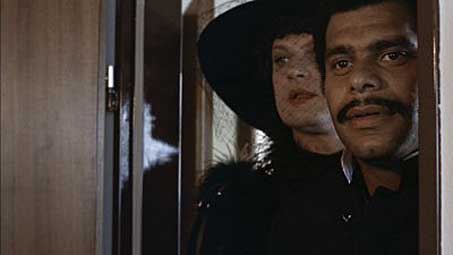
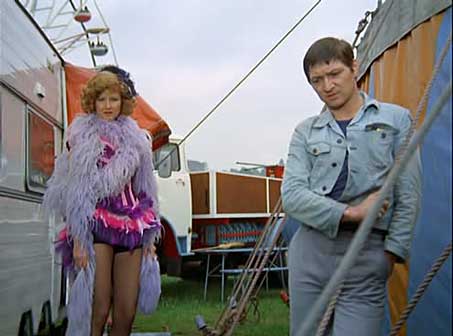
Fox and His Friends (Faustrecht der Freiheit), 1975, chronicles the sad tale of Fox, played by Fassbinder himself, a homely gay man who suddenly finds himself the toast of high society when he wins $500,000 in a lottery. Fox is a member of a circus side show that is shut down by the police. A chance encounter in a public lavatory with Max, a wealthy antique dealer, leads to a new life. Max's snobby friends sneer at this young man in desperate need of a bath but, when Fox wins the lottery, they become greedy vultures who welcome him into their circle with open arms.
Fox and His Friends is really about class and the homosexuality of the leads is almost incidental. This is rare for films from the 1970s, even European ones. Rather than explore coming out issues, Fassbinder instead spins the tale of a poor lower class slob who is abused by rich upper class snobs. What begins as a comedy of manners shifts into a study in humiliation as Eugen continually embarrasses Fox in public by correcting his conduct and belittling his tastes. Later, when the money is almost gone, Eugene coldly announces "We must stop making love every day. We're not starry-eyed lovers any more."
|
 |
|
|
In A Year Of 13 Moons (In Einem Jahr Mit 13 Moden), 1978, is a variation on a similar theme. Volker Spengler is Elvira, a lonely transsexual once known to his acquaintances as Erwin before his journey to Casablanca for a botched operation. [Note 2009: I wonder if director John Cameron Mitchell saw this film when he grew up in Germany and it helped inspire Hedwig and the Angry Inch.] As Erwin, he had a wife and a daughter before falling in love with a wealthy industrialist who dumped him shortly after his sex change. Elvira then entered an abusive relationship with a actor named Christoph.
Elvira may be one of the pathetic characters ever to flicker on the silver screen. Unfortunately, Fassbinder muddies the story with political statements, and keeps the audience at a distance from Elvira by continually offering long monologues instead of dramatizing the scenes she describes. 13 Moons was written, shot and edited by Fassbinder himself following the suicide of one of his lovers, and the personal nature of the film is immediately apparent. But there is often a fine line between personal statement and self indulgence.
13 Moons begins splendidly and then lapses into what may initally appear to be nonsense if you aren't up on 1970s German politics. This is a shame because Spengler's performance as Elvira is remarkable. The film would have been much better had it dramatized more of the events in his/her life instead. Reviewer's note 2008: I recently re-visited 13 Moons; it was during a Fassbinder binge when I discovered now many of his letterboxed DVDs were available at Netflix. I get these strange urges now and then but now I've seen, for the first time, The Bitter Tears Of Petra Van Kant, Beware Of A Holy Whore and Whity, and revisited The Marriage of Maria Braun and Veronika Voss. Anyway, I thought I'd re-visit In a Year Of 13 Moons. I came to it, now, armed with more knowledge about the suicide of his lover Armin Meier, which certainly explains the pallor of death that blankets the film. Knowing now, too, that Fassbinder was influenced by Bertolt Brecht explains the deliberate use of detachment as a dramatic device. At times, this approach works - sometimes too well. That scene in the slaughterhouse made me wish I had listened to my parents in high school and learned their native German because I could have shut my eyes; instead I had to read the subtitles and it was a bit like Alex in A Clockwork Orange, with his eyes clamped open, being forced to watch this carnage on the screen. Fassbinder often demands much from his audience and 13 Moons is a primal scream. Not everyone wants to be subjected to this much pain. This is a remarkable film, but I still wouldn't recommend it for the casual viewer who doesn't feel like a brain workout that night. A cousin from Germany was here for a visit a few years ago and, when I casually mentioned Fassbinder, she made such an odd face. What I didn't realise was that Fassbinder was a household word in Germany and that all the lurid details of his wild personal life were plastered all over the tabloids in the 1970s. There was drugs, parties, gay sex, two marriages, and two suicides. You could say that his outrageous exploits were as well known in his native country as Paris Hilton's are in America. And to think, back in the carefree 70s, we just thought that Fassbinder was just this acclaimed international filmmaker but more people in Germany knew about his scandals than about his films. When I first saw The Marriage of Maria Braun, back in 1978 or 1979, it came without any overseas baggage. I didn't even know that Fassbinder was queer yet.
|
|
 |
|
|
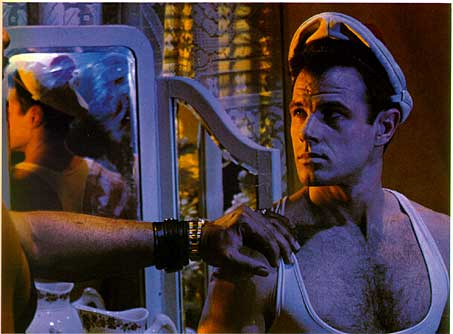
While Fox and 13 Moons' gay and transgendered protagonists are victims, Querelle's is a destroyer. Fassbinder's final film is an adaptation of the 1949 homoerotic sailor-port novel by Jean Genet, Querelle de Brest.
Critical opinions on the film differed. Andy Warhol told Fassbinder that it made him hard and The Advocate called it a "pretentious bore." I, myself, have seen it several times over the last decade and I still don't know what to make of it. Yet Querelle's images have haunted me for most of my adult life. Love it or hate it, no viewer will ever forget it.
Reviewer's note 2007: When I reviewed Querelle 7 years ago, I had only seen the film on a pan-and-scan VHS tape. A few years ago, the film was released in its full cinemascope wide screen on DVD. Let me tell you, seeing the film for the first time in its original screen ratio was a revelation (basically I was missing half of the image when I'd seen it before). It was like I was seeing a different film. I had always considered Querelle to be very clumsily filmed but now I know that is not the case at all. It looked that way because I was only seeing half of Fassbinder's compositions. Besides losing the artistry, many shots do not even make any sense unless you see the film in widescreen. I mean this as the greatest compliment to the late Mr. Fassbinder when I say that Querelle is up there with Kubrick's 2001: A Space Odyssey - it is one of these films that are destroyed when not seen in their entire widescreen glory. You can't tell that I'm a stickler for letterboxing films now, can you? Lawrence of Arabia or West Side Story or Apocalypse Now or Blade Runner in pan and scan? Please...
More On Jean Genet:
|
|
|
|
 Fassbinder
often cited the Hollywood melodramas of Douglas Sirk as a major influence
though stylistically his work seems to have much more in common with experimenters
like Godard. His films are complex, with layers of symbolism piled atop
simple plots featuring the underbelly of German society. A few of his
films candidly depict gay and transgendered characters and three of the
major ones, Fox and His Friends, In a Year
of 13 Moons and Querelle, will
be discussed here.
Fassbinder
often cited the Hollywood melodramas of Douglas Sirk as a major influence
though stylistically his work seems to have much more in common with experimenters
like Godard. His films are complex, with layers of symbolism piled atop
simple plots featuring the underbelly of German society. A few of his
films candidly depict gay and transgendered characters and three of the
major ones, Fox and His Friends, In a Year
of 13 Moons and Querelle, will
be discussed here. 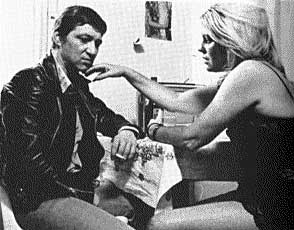 Fox
sheds his worn denim jacket for an expensive leather coat and his old
friends complain that he is putting on airs. Fox snubs them, especially
when a handsome young man named Eugen professes his love. "I'm a
Proletarian, we're more potent," Fox tells his new lover as they
enjoy marathon sex together. Eugen soon talks Fox into buying an exclusive
flat and furnishing it with expensive antiques. Eugen's family owns a
factory which faces bankruptcy and Fox offers financial assistance. It
is soon obvious to everyone, except Fox, that he is being used.
Fox
sheds his worn denim jacket for an expensive leather coat and his old
friends complain that he is putting on airs. Fox snubs them, especially
when a handsome young man named Eugen professes his love. "I'm a
Proletarian, we're more potent," Fox tells his new lover as they
enjoy marathon sex together. Eugen soon talks Fox into buying an exclusive
flat and furnishing it with expensive antiques. Eugen's family owns a
factory which faces bankruptcy and Fox offers financial assistance. It
is soon obvious to everyone, except Fox, that he is being used. 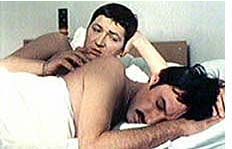 The
story unfolds with the simplicity of a fable, shaded with subtle nuances
of character. It is beautifully acted and photographed. In light of the
director's more avante-garde later works, Fox is one of his most accessible
films. Criticisms have been leveled that it is just another story about
a victimized gay man. True, except that in this case it is other gay men
who are his tormentors. Being a victim is a distinction that Fox shares
with most of the leads in Fassbinder's oeuvre.
The
story unfolds with the simplicity of a fable, shaded with subtle nuances
of character. It is beautifully acted and photographed. In light of the
director's more avante-garde later works, Fox is one of his most accessible
films. Criticisms have been leveled that it is just another story about
a victimized gay man. True, except that in this case it is other gay men
who are his tormentors. Being a victim is a distinction that Fox shares
with most of the leads in Fassbinder's oeuvre. 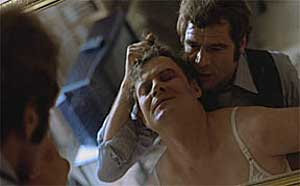 The
film begins with Elvira, dressed as a man to solicit sex in a park, being
beaten by leather men after they discover that she is a woman. This powerful
opening is followed by an ugly and abusive scene where Elvira comes home
in time to see Christoph packing his bags. Elvira confronts past lovers
in the remaining episodes while wallowing in self pity.
The
film begins with Elvira, dressed as a man to solicit sex in a park, being
beaten by leather men after they discover that she is a woman. This powerful
opening is followed by an ugly and abusive scene where Elvira comes home
in time to see Christoph packing his bags. Elvira confronts past lovers
in the remaining episodes while wallowing in self pity. 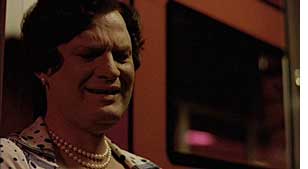 13
Moons is
beautifully photographed with off-centered compositions featuring blank
walls and hallways, as well as scenes filmed in mirrors. It is the very
definition of what most people call an "art film." The viewer
is also assaulted with images of unimaginable ugliness. Erwin's wife was
a butcher's daughter, and Elvira tells the story of their courtship while
the viewer is forced to watch cows being slaughtered and gutted in a meat-packing
plant. The film, in some ways, resembles a novel densely packed with symbolism
like Joyce's Ulysses and demands much from its audience - including
multiple viewings just to comprehend what is going on!
13
Moons is
beautifully photographed with off-centered compositions featuring blank
walls and hallways, as well as scenes filmed in mirrors. It is the very
definition of what most people call an "art film." The viewer
is also assaulted with images of unimaginable ugliness. Erwin's wife was
a butcher's daughter, and Elvira tells the story of their courtship while
the viewer is forced to watch cows being slaughtered and gutted in a meat-packing
plant. The film, in some ways, resembles a novel densely packed with symbolism
like Joyce's Ulysses and demands much from its audience - including
multiple viewings just to comprehend what is going on! 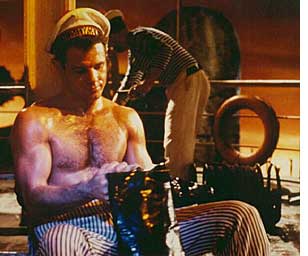 The
image of the virile sailor has fascinated many gay artists, but unlike
Melville's cherubic sailor, Billy Budd, Genet's Querelle is the angel
of death. Unsure of his true nature, Querelle has sex with, and then betrays,
almost every character in the novel. The slight plot is padded with long
erotic descriptions of Querelle's handsome appearance, mixed with religious
symbolism, doppelgangers and existentialist philosophy. Fassbinder tries
to find a cinematic equivalent to Genet's elaborate prose by stylizing
everything in his film... from the settings to the acting.
The
image of the virile sailor has fascinated many gay artists, but unlike
Melville's cherubic sailor, Billy Budd, Genet's Querelle is the angel
of death. Unsure of his true nature, Querelle has sex with, and then betrays,
almost every character in the novel. The slight plot is padded with long
erotic descriptions of Querelle's handsome appearance, mixed with religious
symbolism, doppelgangers and existentialist philosophy. Fassbinder tries
to find a cinematic equivalent to Genet's elaborate prose by stylizing
everything in his film... from the settings to the acting.  Brad
Davis stars as Querelle, the murderous sailor and the object of everyone's
affection in the port town of Brest. Querelle
begins as shipbound sailors tell tales about Brest's notorious brothel
where all losers at dice have to sleep with the owner, Nono (Gunther Kaufmann
- whom Fassbinder called his "Bavarian Negro.") When Querelle
deals drugs with Nono, he is reunited with his rivalrous brother, Robert
- the current boytoy of Nono's wife, Madame Lysiane (Jeanne Moreau). Lysiane
is smitten by Querelle from the moment he enters the brothel. The ship's
captain, Seblon (Franco Nero), is also smitten by Querelle and
delivers long erotic monologues into his tape recorder.
Brad
Davis stars as Querelle, the murderous sailor and the object of everyone's
affection in the port town of Brest. Querelle
begins as shipbound sailors tell tales about Brest's notorious brothel
where all losers at dice have to sleep with the owner, Nono (Gunther Kaufmann
- whom Fassbinder called his "Bavarian Negro.") When Querelle
deals drugs with Nono, he is reunited with his rivalrous brother, Robert
- the current boytoy of Nono's wife, Madame Lysiane (Jeanne Moreau). Lysiane
is smitten by Querelle from the moment he enters the brothel. The ship's
captain, Seblon (Franco Nero), is also smitten by Querelle and
delivers long erotic monologues into his tape recorder. 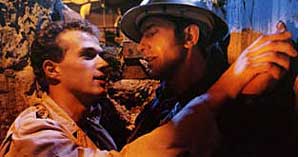 Querelle
pretends to seduce, and then murders, his smuggling accomplice. He then
loses at dice, on purpose, to Nono. "No kissing," Querelle
demands. That would be too feminine. This is followed by another sexual
encounter with the leather-clad Chief of Police. He then befriends, makes
love to, and betrays a sexually confused dock worker. Finally, Seblon
rescues Querelle from a street fight and the two men return to the ship
arm-in-arm.
Querelle
pretends to seduce, and then murders, his smuggling accomplice. He then
loses at dice, on purpose, to Nono. "No kissing," Querelle
demands. That would be too feminine. This is followed by another sexual
encounter with the leather-clad Chief of Police. He then befriends, makes
love to, and betrays a sexually confused dock worker. Finally, Seblon
rescues Querelle from a street fight and the two men return to the ship
arm-in-arm. 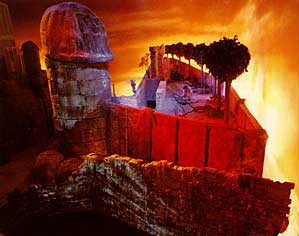 Forget
a conventional plot, this is a film that can only be enjoyed for its stylistic
excesses. Querelle is probably
one of the "gayest" films in cinema history. The very artificial
set is always bathed in a warm red glow, and is dotted with castle towers
that are, literally, shaped like penises. The hell-like atmosphere oozes
homo-eroticism at every turn, and every character is defined by his sexuality.
One gets the impression that Fassbinder was trying to depict his favorite
wet dream on celluloid. While obviously the work of a once-brilliant artist,
many incoherent scenes suggest that the director's drug-use was taking
its toll.
Forget
a conventional plot, this is a film that can only be enjoyed for its stylistic
excesses. Querelle is probably
one of the "gayest" films in cinema history. The very artificial
set is always bathed in a warm red glow, and is dotted with castle towers
that are, literally, shaped like penises. The hell-like atmosphere oozes
homo-eroticism at every turn, and every character is defined by his sexuality.
One gets the impression that Fassbinder was trying to depict his favorite
wet dream on celluloid. While obviously the work of a once-brilliant artist,
many incoherent scenes suggest that the director's drug-use was taking
its toll. 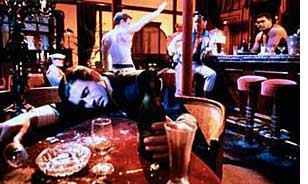 Part
of the blame can be assigned to Genet's novel, a work which does not lend
itself easily towards cinematic adaptation. Attempts to infuse Genet's
poetic language into the film bogs the storyline down with title cards
and intrusive narration. This even seeps into the dialogue. For example,
Querelle whispers to Seblon that "afterwards I may rest across your
thighs, as a pieta, and you will watch over me as Mary watches over the
dead Jesus." Adding to this aura of seriousness is a baritone choir
dominating the soundtrack. The action in Querelle
moves at a snail's pace.
Part
of the blame can be assigned to Genet's novel, a work which does not lend
itself easily towards cinematic adaptation. Attempts to infuse Genet's
poetic language into the film bogs the storyline down with title cards
and intrusive narration. This even seeps into the dialogue. For example,
Querelle whispers to Seblon that "afterwards I may rest across your
thighs, as a pieta, and you will watch over me as Mary watches over the
dead Jesus." Adding to this aura of seriousness is a baritone choir
dominating the soundtrack. The action in Querelle
moves at a snail's pace.  Visually,
the late Brad Davis is perfect as Querelle. Davis was handsome, in a Montgomery
Clift mode, while resembling rough trade. He spends most of the film wearing
skin tight white clothes, his large hairy chest continually on display
through a sweeping tank top. Almost every shot is a pose, like a Tom of
Finland drawing that has come to life. It's hard to judge his acting,
or anyone's for that matter, because the film is often badly dubbed. Franco
Nero comes off the best in a movie filled with lifeless performances.
Jeanne Moreau, a longtime diva of European cinema, resembles a old drag
queen doing Bette Davis.
Visually,
the late Brad Davis is perfect as Querelle. Davis was handsome, in a Montgomery
Clift mode, while resembling rough trade. He spends most of the film wearing
skin tight white clothes, his large hairy chest continually on display
through a sweeping tank top. Almost every shot is a pose, like a Tom of
Finland drawing that has come to life. It's hard to judge his acting,
or anyone's for that matter, because the film is often badly dubbed. Franco
Nero comes off the best in a movie filled with lifeless performances.
Jeanne Moreau, a longtime diva of European cinema, resembles a old drag
queen doing Bette Davis. 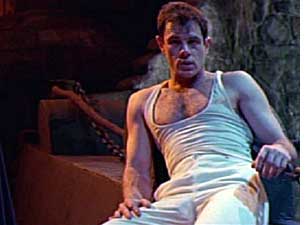 Each
of these films are filled with the director's own self-loathing, which
makes reviewing them as gay cinema problematic. Yet they boldly portrayed
gay characters during a time when the subject was far from commonplace.
Each is remarkable in its own way, but hardly the sort that fosters mass
popularity. For those with patience, these films have many riches to offer.
At the very least, they are unique curiosities in the history of gay cinema.
All three films can be rented at Mondo Video, 1109 Elmwood Avenue. Querelle
can also be rented at Rainbow Pride, located in Buddies, 31 Johnson Park.
Each
of these films are filled with the director's own self-loathing, which
makes reviewing them as gay cinema problematic. Yet they boldly portrayed
gay characters during a time when the subject was far from commonplace.
Each is remarkable in its own way, but hardly the sort that fosters mass
popularity. For those with patience, these films have many riches to offer.
At the very least, they are unique curiosities in the history of gay cinema.
All three films can be rented at Mondo Video, 1109 Elmwood Avenue. Querelle
can also be rented at Rainbow Pride, located in Buddies, 31 Johnson Park.