
GAY
FILM REVIEWS BY MICHAEL D. KLEMM


|
||||||
|
GAY
FILM REVIEWS BY MICHAEL D. KLEMM
|
||||||
|
|
|
|
|
|
|
|
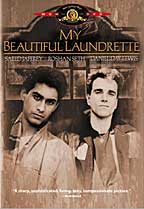
My Beautiful Laundrette MGM Video, Director: Screenplay: Starring:
Rated R, 98 minutes
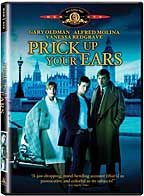
Prick Up Your Ears MGM Video, Director: Screenplay: Starring: Rated R, 110 minutes
|
Indie
Picture Double Feature Before achieving international success with Dangerous Liasions and The Grifters, Stephen Frears directed two independent films that featured a gay couple at the center of the action. The first, a work of fiction, presented a very positive portrayal of two men in love. The second, a biography on the life of British playwright Joe Orton, was a study in dysfunction to the ninth degree.
My Beautiful Laundrette (1985) is a tale of "forbidden love" that features Gordon Warneck and a young Daniel Day Lewis as lovers set against a backdrop of the problems faced by Pakastanis living in South London. Warnecke plays Omar, a handsome Pakastani youth who cares for his sick father (Roshan Seth). When Omar goes to work for his seedy and wealthy Uncle Nasser, he is quickly seduced by the London underworld and the lure of fast money. Nasser is played by Saeed Jaffrey (He played sidekick to Sean Connery and Michael Caine in John Huston's film of Rudyard Kipling's The Man Who Would Be King). He hands over the management of a run-down laundrette to Omar, while meanwhile hoping to groom him for a position of power - and marry off his difficult daughter Tanya.
Despite its serious intent and complicated plot, My Beautiful Laundrette is for the most part comic. It was also the subject of much controversy amongst London's Pakastani community when it was first aired. That this was filmed for Britain's Channel 4 is certainly a comment on the sad state of American television. My Beautiful Laundrette contains some of the most tender love scenes between men ever filmed. And it certainly didn't hurt the up-and-coming career of Daniel Day Lewis. (Are you listening Hollywood?)
|
 |
|
|
Prick Up Your Ears (1987) boasts bravura performances by Gary Oldman and Alfred Molina as playwright Joe Orton and his unbalanced lover, Kenneth Halliwell. Orton was the toast of the London stage in the mid 1960s, delighting and shocking audiences with such black comedies as Loot, What The Butler Saw and Entertaining Mr. Sloan. Like Oscar Wilde before him, Orton was gay and his biting satires attacked upper class manners. Both artists were silenced at the height of their craft. In Orton's case, his fall came as the result of a jealous and ignored partner - who brutally murdered him with a hammer.
|
|
|
|
|
|
|
|
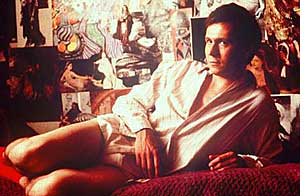 Orton
was a true iconoclast who lived by his own rules without guilt. He would
go to great lengths to shock people, even using his own mother's false teeth
as a prop in one of his plays. The extent of his promiscuity is nowhere
more apparent than when he picks up a working class stiff in an abandoned
warehouse on the day of his mother's funeral. While perhaps lacking as a
definitive film biography, Prick Up Your Ears
is strongest when depicting Orton and Halliwell's "marriage from hell." Orton
was a true iconoclast who lived by his own rules without guilt. He would
go to great lengths to shock people, even using his own mother's false teeth
as a prop in one of his plays. The extent of his promiscuity is nowhere
more apparent than when he picks up a working class stiff in an abandoned
warehouse on the day of his mother's funeral. While perhaps lacking as a
definitive film biography, Prick Up Your Ears
is strongest when depicting Orton and Halliwell's "marriage from hell."
|
|
 In
the politically correct 90s, when most gay groups are clamoring for positive
portrayals of gays on the silver screen, this might seemlike a step backwards.
To present Orton in any other manner, however, would be dishonest. At the
time of its original release, the film was quite daring. Frears' directing,
combined with top-notch acting, a terrific script by playwright Alan Bennett,
and a fine attention to period details make Prick Up Your Ears a
film well worth renting. In
the politically correct 90s, when most gay groups are clamoring for positive
portrayals of gays on the silver screen, this might seemlike a step backwards.
To present Orton in any other manner, however, would be dishonest. At the
time of its original release, the film was quite daring. Frears' directing,
combined with top-notch acting, a terrific script by playwright Alan Bennett,
and a fine attention to period details make Prick Up Your Ears a
film well worth renting.
|
|
|
[Reviewer's note, 2008: I just watched Prick Up Your Ears again and it is still a great film. In retrospect, Halliwell's portrayal may have been exaggerated (reports say that we wasn't that grotesque) yet Alfred Molina is so good that Halliwell doesn't come across as a cartoon. You'd want to kill him if he lived with you but he still inspires pity. Gary Oldman is nothing short of brilliant as Orton and their scenes together are screen magic. I'd forgotten how funny it sometimes is in a black comedy sort of way. In fact, their life together is depicted as if it was an Orton play. Consider the scene where Orton tells Halliwell to "go have a wank" and Halliwell shrieks "Have a wank? Did you say have a WANK??? Do you know how long it takes me to get ready to have a wank?" |
|
|
|
|
|
Alfred Molina also appears in: Vanessa
Redgrave also appears in: More on Britain's
Channel 4: |
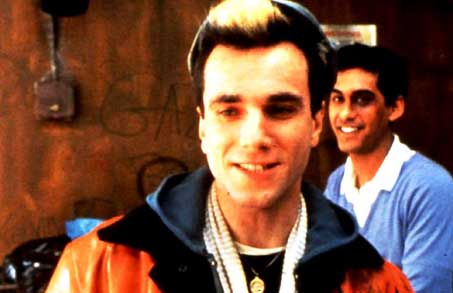
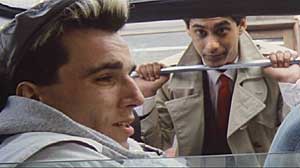 Omar
has other plans however. After meeting his boyhood chum Johnny, (a young
and hot blonde Daniel Day Lewis), the film veers off into uncharted territories
when the two men share a sudden and affectionate kiss. It is a credit
to both director Frears and screenwriter Hanif Kureishi (The Buddha
of Suburbia) that this moment happens without apology or explanation.
Their simple love affair is, in fact, a breath of fresh air amidst the
strife-ridden plot.
Omar
has other plans however. After meeting his boyhood chum Johnny, (a young
and hot blonde Daniel Day Lewis), the film veers off into uncharted territories
when the two men share a sudden and affectionate kiss. It is a credit
to both director Frears and screenwriter Hanif Kureishi (The Buddha
of Suburbia) that this moment happens without apology or explanation.
Their simple love affair is, in fact, a breath of fresh air amidst the
strife-ridden plot.  Their's
is not the only example of "forbidden love" depicted. Uncle
Nassar is having an affair with a white upper class English woman, much
to the disgust of his family. Her gaudy white fur coats stand in direct
contrast to the more traditionally dressed Indian women back at the Patriarch's
home. My Beautiful Laundrette's
themes of illicit love and class boundaries are summed up brilliantly
in one striking camera shot where the two are seen dancing through the
one-way glass of the Laundrette's office while Johnny and Omar passionately
make love in the foreground.
Their's
is not the only example of "forbidden love" depicted. Uncle
Nassar is having an affair with a white upper class English woman, much
to the disgust of his family. Her gaudy white fur coats stand in direct
contrast to the more traditionally dressed Indian women back at the Patriarch's
home. My Beautiful Laundrette's
themes of illicit love and class boundaries are summed up brilliantly
in one striking camera shot where the two are seen dancing through the
one-way glass of the Laundrette's office while Johnny and Omar passionately
make love in the foreground.  My
Beautiful Laundrette
is a rich and complex film that examines Pakastani life in London, complete
with issues of prejudice, assimilation, and class struggles. Omar's father,
once a brilliant journalist in his native land, represents tradition and
the old regime, while Nassar believes in England and boasts that one has
to know how to "squeeze the tits of the system." Omar is torn
between returning to college and making a fast buck. Johnny, on the other
hand, is a working class punk who just wants to leave his past behind.
His prior affiliation with the National Front eventually causes friction
between the two. His affection, however, for Omar is genuine, and he is
genuinely hurt when Omar succumbs to the good life and comtemplates marriage
with Tanya as a stepping stone to better societal status. "I'm not
going to be beaten down by this country," Omar tells Johnny in a
fit of confused anger. "When we were in school, you and your friends
were kicking me around the place. And what are you doing now? Washing
my floor and that's how I like it."
My
Beautiful Laundrette
is a rich and complex film that examines Pakastani life in London, complete
with issues of prejudice, assimilation, and class struggles. Omar's father,
once a brilliant journalist in his native land, represents tradition and
the old regime, while Nassar believes in England and boasts that one has
to know how to "squeeze the tits of the system." Omar is torn
between returning to college and making a fast buck. Johnny, on the other
hand, is a working class punk who just wants to leave his past behind.
His prior affiliation with the National Front eventually causes friction
between the two. His affection, however, for Omar is genuine, and he is
genuinely hurt when Omar succumbs to the good life and comtemplates marriage
with Tanya as a stepping stone to better societal status. "I'm not
going to be beaten down by this country," Omar tells Johnny in a
fit of confused anger. "When we were in school, you and your friends
were kicking me around the place. And what are you doing now? Washing
my floor and that's how I like it." As
the film opens, the police find the bodies of both Orton and Halliwell
along with a suicide note that states: "If you read his diaries,
all will be explained."
As
the film opens, the police find the bodies of both Orton and Halliwell
along with a suicide note that states: "If you read his diaries,
all will be explained." 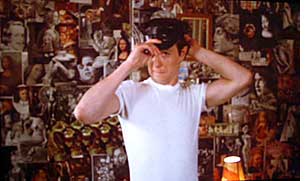 One
of the film's many highlights is Oldman's performance as Orton. Gary Oldman
is gifted with an uncanny knack for becoming the characters that he portrays.
(For more proof of that statement, see his electric performance as Sid
Vicious in Sid and Nancy.) He even looks like Orton in Prick
Up Your Ears, where he is charming one moment, and unfeeling
in the next. Alfred Molina is also a revelation as Halliwell, the homely
and unglued lover who resents his reduced role in the shadows to his famous
partner.
One
of the film's many highlights is Oldman's performance as Orton. Gary Oldman
is gifted with an uncanny knack for becoming the characters that he portrays.
(For more proof of that statement, see his electric performance as Sid
Vicious in Sid and Nancy.) He even looks like Orton in Prick
Up Your Ears, where he is charming one moment, and unfeeling
in the next. Alfred Molina is also a revelation as Halliwell, the homely
and unglued lover who resents his reduced role in the shadows to his famous
partner. 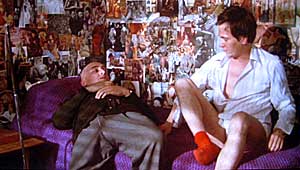 Halliwell,
an artist in his own right, collaborated with Orton on many of his works,
and was resentful of the lack of attention paid to him. Though he is like
every ignored wife that ever graced the screen, the conflicts raised are presented
in many shades of gray. Orton is blatantly unfaithful to Halliwell, even
resorting to cruising subways and public lavatories. During one of the
films's more disturbing scenes, Orton tosses Halliwell's pills at him
while yelling "fetch! fetch!" In Orton's defense, Halliwell's
whining and mood swings would annoy Mother Theresa. Nevertheless,
Molina's portrayal of Halliwell often evokes pity. The saddest moment
of the film occurs when he watches, dejected, in the rain as Orton drives
off in Paul McCartney's limousine.
Halliwell,
an artist in his own right, collaborated with Orton on many of his works,
and was resentful of the lack of attention paid to him. Though he is like
every ignored wife that ever graced the screen, the conflicts raised are presented
in many shades of gray. Orton is blatantly unfaithful to Halliwell, even
resorting to cruising subways and public lavatories. During one of the
films's more disturbing scenes, Orton tosses Halliwell's pills at him
while yelling "fetch! fetch!" In Orton's defense, Halliwell's
whining and mood swings would annoy Mother Theresa. Nevertheless,
Molina's portrayal of Halliwell often evokes pity. The saddest moment
of the film occurs when he watches, dejected, in the rain as Orton drives
off in Paul McCartney's limousine. 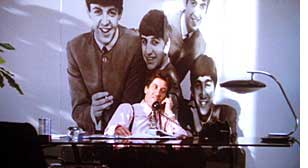 Daring
it was, too, for its time in its depiction of sexuality. Orton's cruising
is arousing and disturbing at the same time; a scene in a public lavatory
looks like Night
of the Living Dead after Orton turns out the light. Another scene where
Orton coaxes Halliwell into a threeway with a pickup is masterfully filmed
and acted - Halliwell is first timid, and then gives in, while Orton
leans against a wall and grins. The period detail is excellent and I especially
loved the recreation of the famous collage that covered the walls of their
flat. Stephen Frears did a good job on this film, and Alan Bennett's script
is terrific. Bennett also wrote The Madness of King George and
The History Boys. The framing story in which Wallace Shaun researches
the book, while his unsung wife transcribes Orton's diaries for him, beautifully doubles
the Orton and Halliwell dynamic (The wife
gets annoyed when she is ignored by Vanessa Redgrave). Good use of music in the film too, especially The Beatles' "A Day in the Life" at the end. Oh, and the scene
where Beatles manager Brian Epstien (sitting in front of a wall-sized
picture of The Beatles) rejects Orton's script is a classic. There could
have been a bit more about Orton's plays but, aside from that, this film
is one of the greats.
Daring
it was, too, for its time in its depiction of sexuality. Orton's cruising
is arousing and disturbing at the same time; a scene in a public lavatory
looks like Night
of the Living Dead after Orton turns out the light. Another scene where
Orton coaxes Halliwell into a threeway with a pickup is masterfully filmed
and acted - Halliwell is first timid, and then gives in, while Orton
leans against a wall and grins. The period detail is excellent and I especially
loved the recreation of the famous collage that covered the walls of their
flat. Stephen Frears did a good job on this film, and Alan Bennett's script
is terrific. Bennett also wrote The Madness of King George and
The History Boys. The framing story in which Wallace Shaun researches
the book, while his unsung wife transcribes Orton's diaries for him, beautifully doubles
the Orton and Halliwell dynamic (The wife
gets annoyed when she is ignored by Vanessa Redgrave). Good use of music in the film too, especially The Beatles' "A Day in the Life" at the end. Oh, and the scene
where Beatles manager Brian Epstien (sitting in front of a wall-sized
picture of The Beatles) rejects Orton's script is a classic. There could
have been a bit more about Orton's plays but, aside from that, this film
is one of the greats.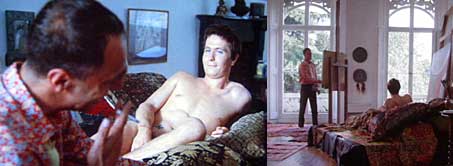 [
[